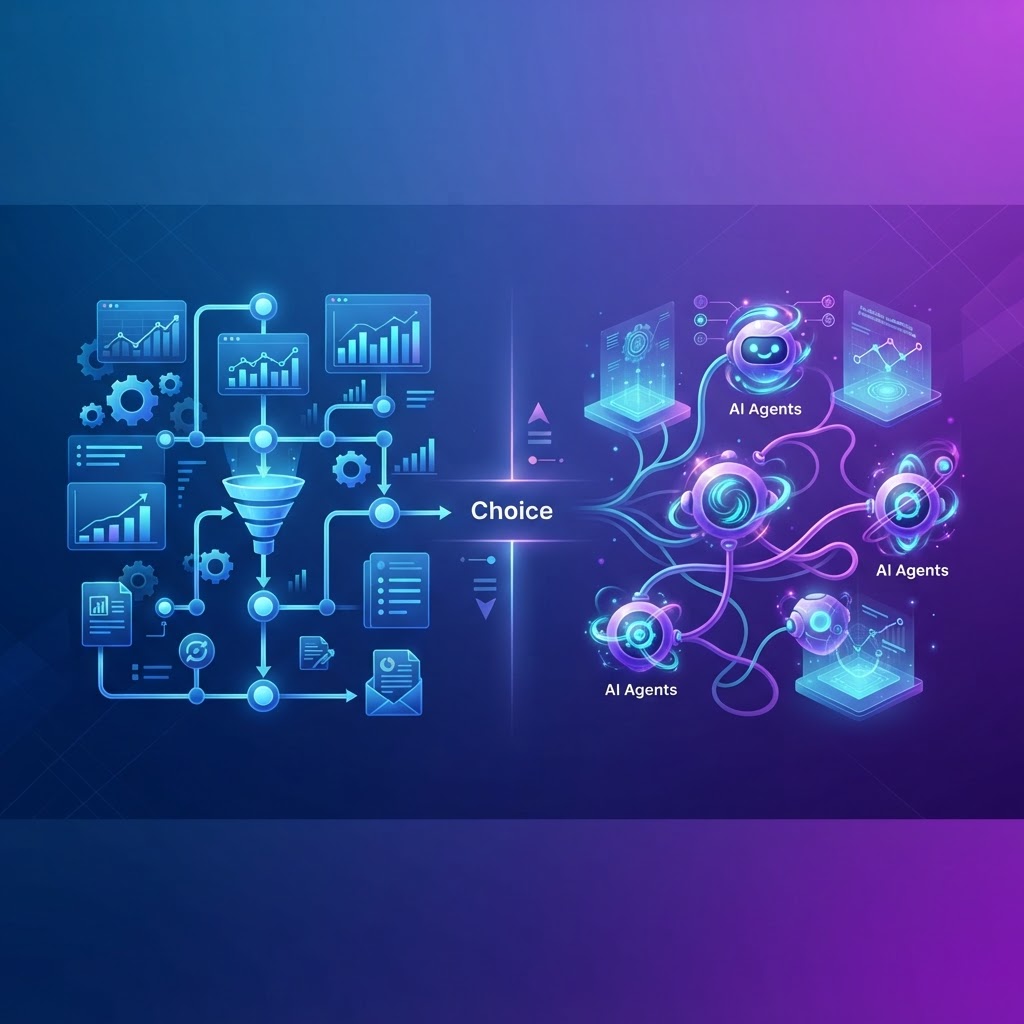
Small business owners face a constant struggle: balancing limited time with the need for consistent marketing results. You are likely deciding whether to stick with traditional, rule-based marketing automation software or shift toward autonomous AI marketing agents. The core difference lies in agency: software follows your specific commands, while AI agents make decisions to achieve the outcomes you define.
Understanding the Core Difference
Traditional marketing automation software operates on "if-this-then-that" logic. You build a workflow, and the system executes it precisely as instructed. If you set up an email sequence, it sends the email when the criteria are met. It is reliable but rigid; it cannot pivot based on new data without your manual intervention. This is excellent for repetitive, predictable tasks where you want total control over every step.
Autonomous AI marketing agents, by contrast, are designed to work toward a specific goal, such as increasing conversion rates or managing engagement. Rather than just executing a rule, an agent analyzes data, identifies obstacles, and adapts its approach. It does not just follow the script; it optimizes the script in real-time.
The Trade-off: Control vs. Autonomy
When you choose between AI marketing agents vs software, you are weighing granular control against operational speed. Traditional tools require you to be the architect, the builder, and the project manager. You must define every variable and monitor for performance dips yourself. If your business strategy changes, you must manually rebuild your automations.
AI agents function more like a specialized employee. You provide the strategic direction—such as launching a new product campaign—and the agent handles the heavy lifting of automated content creation, target audience adjustments, and posting schedules. The primary benefit is speed. These systems allow for marketing without an agency, handling complex tasks that would otherwise require multiple software subscriptions and hours of manual oversight.
When to Choose Each Approach
Use traditional software when you have highly standardized, repetitive processes where variance is undesirable. For example, transactional email receipts or simple scheduling tasks benefit from the predictability of legacy systems. This is often categorized under standard marketing automation tools.
Opt for AI agents when your goal is growth and scale. If you are struggling with saving time on marketing, an agent can take over the creative and analytical heavy lifting that standard software cannot handle. They excel in scenarios where market conditions change, such as managing social media trends or optimizing ad creative on the fly.
Putting It Into Practice
Audit your current workflow to see where you spend the most time. If you are spending hours tweaking settings or manually analyzing performance, you are likely using the wrong type of tool for your current scale. Identify one area—such as social media management—and test an agent-driven approach. You will likely find that the reduction in manual labor allows you to focus on high-level business strategy rather than tactical execution.
How PromoMax Can Help
PromoMax bridges the gap between simple automation and advanced autonomous action. We offer a suite of AI tools for small businesses that function as an extension of your team. Whether you need an AI marketing assistant to draft campaigns or full-scale automation, we provide the infrastructure to run your automated digital marketing effectively. Our platform is built specifically for small business owners who need to compete with larger companies without the overhead of a large staff.
Related Reading
Your AI Marketing Team, Working 24/7
Stop choosing between software complexity and human limitations. With PromoMax, you gain an autonomous partner that executes your vision while you focus on running your business. It is time to upgrade your tech stack to a system that thinks as fast as it works.