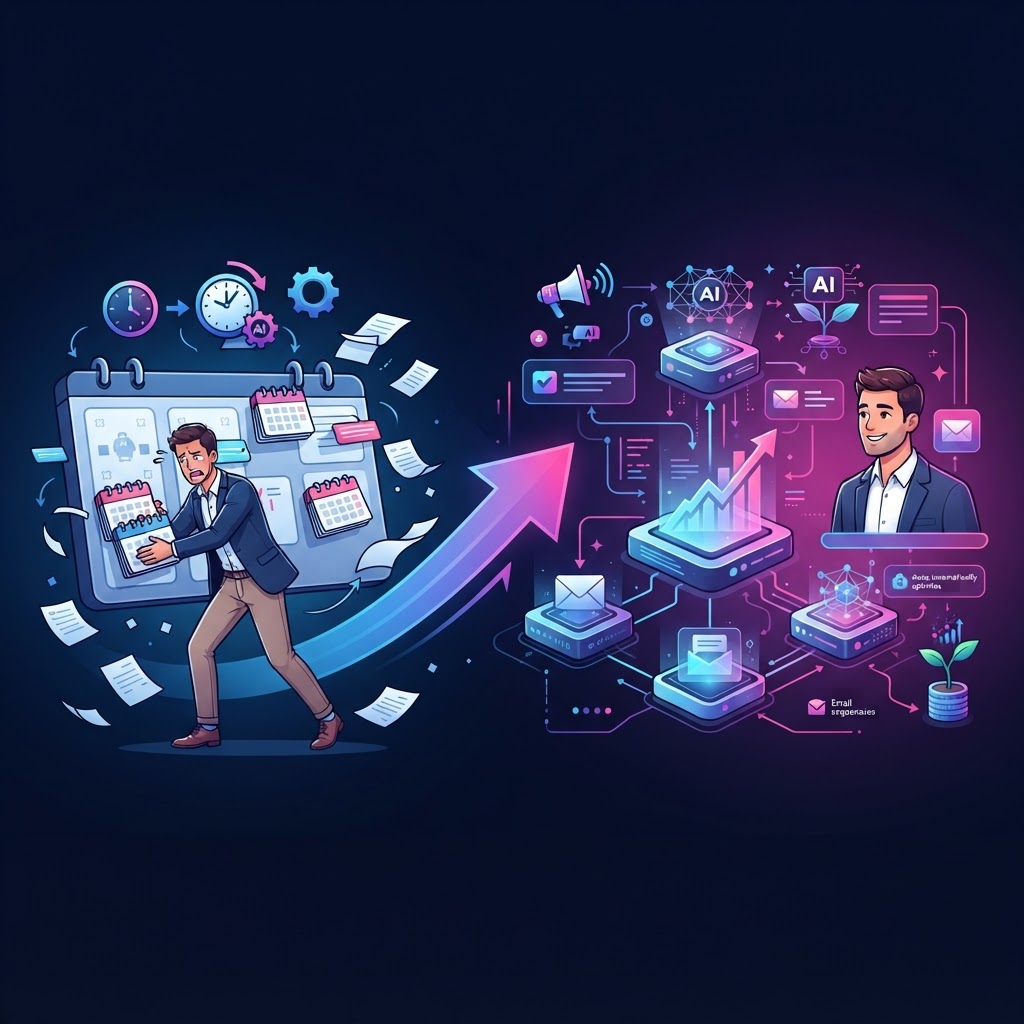
Transitioning from manual scheduling to AI marketing agents becomes necessary when your business outgrows the ability to react in real-time to market changes, content performance data, and customer engagement. If you are spending more than 20% of your work week manually plugging content into a calendar, you have reached the efficiency ceiling of traditional scheduling tools. Moving to agentic workflows allows you to shift from 'task completion' to 'strategic oversight,' where AI doesn't just post content—it learns from your audience's behavior to optimize future outputs autonomously.
Why Is Manual Scheduling Creating a Bottleneck?
Manual scheduling relies on a static, 'set-it-and-forget-it' mindset. While this works for early-stage operations, it fails as complexity grows. According to HubSpot's 2025 State of Marketing report, businesses that prioritize adaptive automation over rigid manual calendars see a 34% higher engagement rate due to more timely content delivery. When you use static tools, you miss the 'micro-moments' where your audience is most likely to convert because your content is locked into a pre-determined slot regardless of performance data.
What Are the Key Signs It Is Time to Upgrade?
Recognizing the need for a shift involves looking beyond your calendar. First, if your content performance is flatlining despite consistent posting, your manual workflow likely lacks the agility to pivot. Second, if you find yourself spending more time formatting posts than analyzing strategy, you are misallocating your human capital. Third, if you are struggling to maintain a consistent brand voice across multiple channels without constant manual intervention, you need the guardrails that AI agents for marketing provide.
How Do Agentic Workflows Differ from Standard Automation?
Standard automation is binary: 'if this happens, do that.' Agentic marketing is iterative. An AI agent evaluates the context of a post, reviews historical engagement, and adjusts the tone or timing before execution. This transition moves your marketing from a series of disjointed tasks to a continuous, self-optimizing loop. This is a critical step for AI marketing for small business owners who lack large teams to handle multi-channel management.
Putting It Into Practice: How to Start the Transition
You don't need to switch overnight. Start by auditing your current workflow: identify the repetitive, low-value tasks that take up the most time—like generating captions or resizing images. Use tools like AI content generator suites to handle these tasks, freeing up your time for higher-level planning. Once those tasks are managed, move to automating social media distribution based on performance analytics. This phased approach minimizes disruption while building the infrastructure for a fully automated digital marketing strategy.
How PromoMax Can Help
PromoMax is built specifically to bridge the gap between simple scheduling and full AI agents for small business. By consolidating your content creation, scheduling, and performance monitoring into one system, PromoMax allows you to move toward marketing on autopilot. Our platform doesn't just hold your calendar; it functions as an AI marketing assistant that handles execution so you can focus on scaling your revenue.
FAQ: Transitioning to Agentic Marketing
Is agentic marketing too complex for a small business?
Not at all. Modern marketing automation tools are designed to be plug-and-play, allowing you to activate agents without needing a technical background or dedicated IT staff.
Will I lose control over my brand voice?
Quite the opposite. Using AI agents allows you to set clear, brand-specific guardrails that the system adheres to across every post, ensuring more consistency than manual work ever could.
What is the biggest risk of staying with manual scheduling?
The primary risk is 'opportunity cost.' While your competitors adopt autonomous tools that react to market shifts in seconds, manual scheduling keeps you trapped in yesterday’s plan.
Can I start with just one platform?
Yes. Many businesses begin by automating one channel—like Instagram or LinkedIn—before expanding their automated marketing workflow to other platforms.
Related Reading
- The Rise of Autonomous Marketing: How AI Agents Manage Day-to-Day Operations
- What are the benefits of using AI marketing automation for small business?
- PromoMax vs Buffer: Replacing Manual Scheduling with Full Lifecycle Automation
Your AI Marketing Team, Working 24/7
Stop managing individual posts and start managing your brand’s growth. With PromoMax, you gain an autonomous team that learns, adapts, and executes for you around the clock.