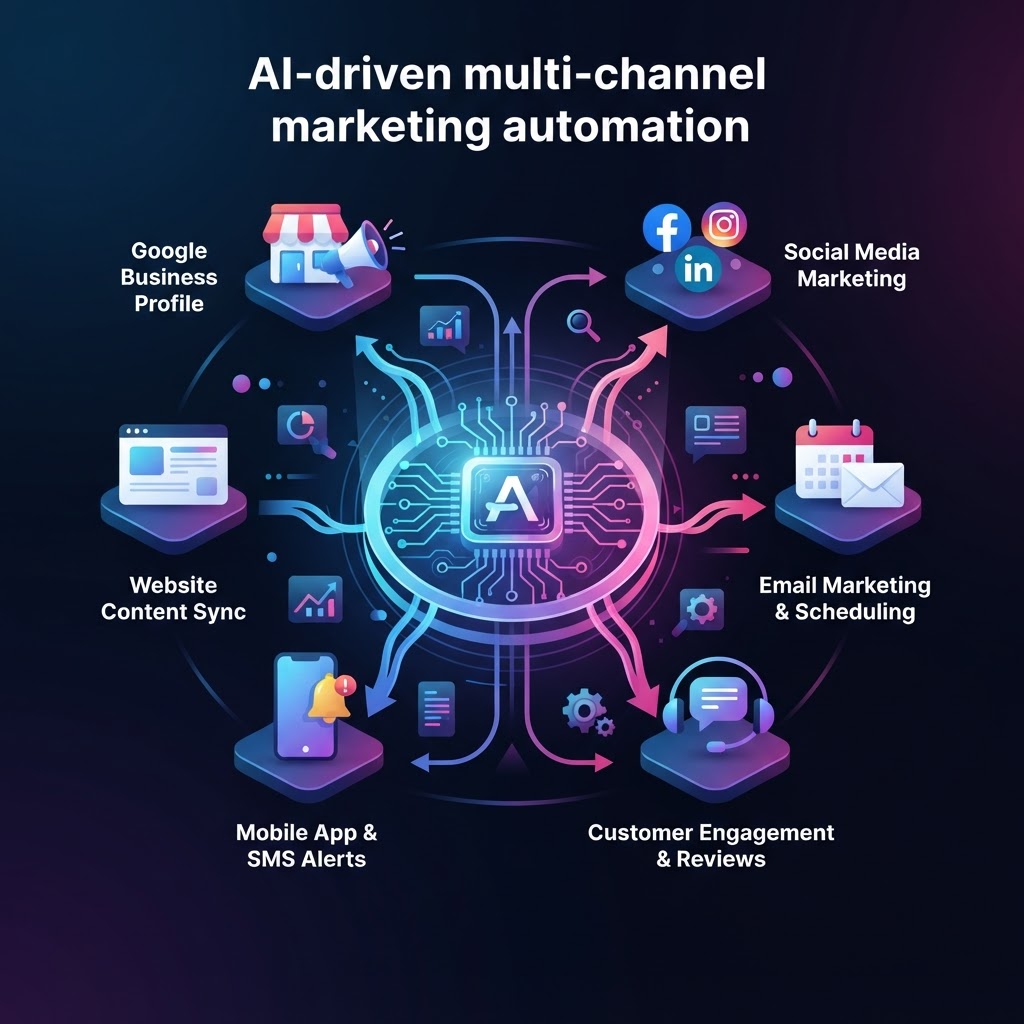

You are likely balancing a dozen roles at once, making every dollar and every minute in your schedule precious. When you choose to invest in new technology, you need to ensure that your digital strategy is actually moving the needle for your bottom line. By mastering the art of measuring AI marketing ROI, you will transform your approach from guesswork into a data-driven system that scales your business effectively.
Short on time? See what it would write for your business — free, in about 30 seconds.
Defining AI Marketing Metrics for Your Business
You cannot improve what you do not measure. To determine the real-world success of your AI marketing for small business efforts, start by categorizing your performance indicators into three distinct buckets: efficiency, engagement, and conversion.
1. Efficiency Metrics: Calculating Time Reclamation
The most immediate benefit for a small business is often the hours reclaimed from manual labor. If an AI content generator helps you produce three high-quality social media posts in the time it once took to draft a single caption, that is a direct increase in your operational capacity. To calculate this:
- Identify your target hourly rate or the hourly cost of your marketing staff.
- Measure the time spent on content creation, scheduling, and research before and after implementing your tools.
- Multiply the hours saved per week by your hourly rate to find your weekly efficiency gain.
This is often the most underrated metric, yet it provides the fastest proof of value. If you save five hours a week, you have essentially gained a full workday to focus on high-level strategy or client service.
2. Engagement Metrics: The Quality of Interaction
Are your AI-assisted emails or posts actually connecting with your audience? You must look beyond vanity metrics like follower counts and focus on engagement depth. Monitor metrics such as:
- Email open rates and click-through rates (CTR).
- Average engagement rate per post on social platforms.
- The quality of comments and direct messages received.
If you are using automated social media posting, look for a consistent upward trend in interactions compared to your manual publishing efforts. If your engagement dips, it is an indicator that your AI prompts may need refinement to maintain a human tone.
3. Conversion Metrics: Linking AI to Revenue
Ultimately, your marketing must drive sales. You should track the path your customers take to reach a purchase. If a customer journey originated from an AI-optimized landing page, that conversion should be attributed to your automated strategy. Use tracking links to see which AI-written pieces lead directly to checkout pages.
How to Calculate Marketing Automation Value
To calculate the financial success of your marketing automation, use this specific formula: (Total Revenue from Automated Channels - Cost of Automation Tools) / Cost of Automation Tools. A positive percentage indicates a healthy return. If your cost of tools is 100 dollars and the revenue attributed to those channels is 500 dollars, your ROI is 400 percent.
Common Pitfalls in ROI Tracking
Many business owners struggle with measuring AI marketing ROI because they fall into common traps. One major mistake is ignoring the cost of the learning curve. When you first adopt a tool, it takes time to set up. Do not count the initial setup hours against your long-term efficiency gains. Another error is relying on tools that promise a miracle without integrating into your sales funnel. Ensure your software talks to your CRM to get an accurate picture of the customer journey.
Putting It Into Practice: A Step-by-Step Approach
Do not try to track everything at once. Focus on one specific area where you are currently using AI, such as AI blogging or email sequence management, and follow these steps:
- Establish a 30-day baseline before activating your new AI process.
- Record your average time spent and average conversion rates during that month.
- Implement the tool and monitor the same metrics for the next 30 days.
- Compare the trends rather than obsessing over daily fluctuations.
Consistency is key. By focusing on these specific data points, you will be able to justify your tech stack costs and optimize your workflow for maximum growth.
Related Reading
See what it writes for YOUR business
Go to promomax.ai right now, enter your website, and get custom posts written for your business in about 30 seconds — free, no credit card. That's hundreds of posts a month on autopilot, written in your voice, published while you run your business. 7-day money-back guarantee, cancel anytime.
Get my free posts