
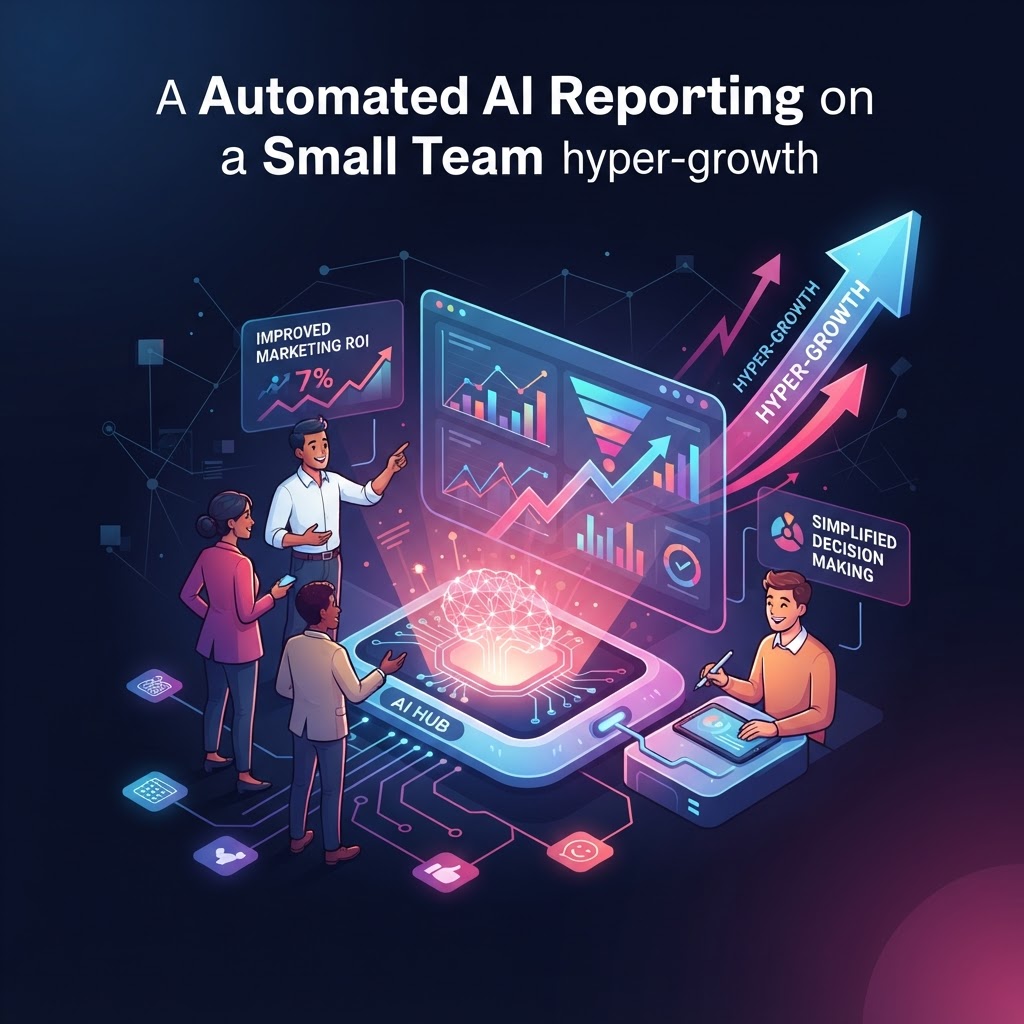
You likely spend hours each week trapped in a cycle of manual data collection, missing the growth opportunities hidden within your own analytics. Track how much time your team spends on manual reporting each week, then test whether introducing automated AI reporting tools reduces that time and frees capacity for proactive growth work.
Short on time? Enter your website and see what it would write for your business — free, in about 30 seconds.
How Do AI Reporting Tools Change SMB Marketing?
Small teams often struggle with fragmented visibility. Your customer journey is scattered across Google Analytics, Facebook Ads Manager, email platforms, and e-commerce backends. Moving data between platforms often drains hours of productivity from a workweek. Before relying on any platform's speed claims, check how often it actually refreshes data and whether it integrates with the tools already in your stack.
Moving Beyond the Spreadsheet Struggle
The primary shift is moving from static rows of numbers to dynamic insights. Review your analytics for patterns between content timing and conversion changes, such as testing whether a specific blog post publish time correlates with a change in organic search conversions. Treat your marketing stack as a connected system and compare results across channels rather than reviewing each app in isolation.
The Cost of Analysis Paralysis
Data-driven decision making for SMBs is often hindered by the sheer volume of available information. When you have too much data and not enough context, you fall into analysis paralysis. Small teams frequently waste hours creating reports that look at the past, rather than planning for the future. Many AI reporting platforms are designed to monitor performance continuously and flag anomalies, such as a sudden dip in engagement or an unexpected spike in high-converting traffic; check how a specific tool defines and surfaces these alerts before you rely on them. This kind of ongoing monitoring can support a feedback loop of continuous, incremental adjustments rather than risky, periodic overhauls, so track your results over time to see whether this approach works for your team.
Optimizing Marketing ROI with Precision
Shift your reporting focus from vanity metrics to leading indicators tied to revenue. Track which content assets drive leads through your AI content marketing funnels, and compare customer acquisition cost (CAC) and lifetime value (LTV) across channels before and after any reporting change.
Common Mistakes to Avoid
- Ignoring lead quality in favor of total traffic volume.
- Failing to set up automated alerts for budget caps.
- Treating AI summaries as the end of the process rather than a starting point for strategy.
By focusing on revenue-generating actions rather than superficial clicks, you can make more informed decisions about where to allocate your marketing budget. Save time on marketing by automating your reporting and focus on scaling your business.
Practical Steps to Implement AI Reporting
Track how much time your reporting process consumes each week to consolidate. Follow these steps to modernize your workflow:
- Audit your stack: List every channel that drives revenue. Ensure each is connected to a centralized reporting dashboard that supports automated data ingestion.
- Set KPI Thresholds: Define the metrics that matter most, such as CPA or Conversion Rate. Configure the AI to trigger alerts when these metrics deviate meaningfully from your baseline, and test different threshold levels to find what reduces noise without missing real shifts.
- Standardize the Weekly Review: Dedicate a consistent block of time each week to review the AI-generated summaries. Check performance weekly to catch shifts early and keep your content strategy on track. Use these insights to identify your top three priority actions for the week.
- Test and Iterate: Use the AI insights to run A/B tests on your landing pages or email subject lines. Let the software track the winners, allowing you to double down on what works without manual calculation.
By automating the heavy lifting of data analysis, you empower your team to focus on creative strategy and customer relationships, which are the two pillars of long-term sustainable growth.
Related Reading
- Unlocking Hyper-Growth: The Impact of AI-Driven Automated Reporting on Small Teams
- The ROI of Switching from Manual Marketing to AI-Powered Automation
- The Rise of Autonomous Marketing: How AI Agents Manage Day-to-Day Operations
See what it writes for YOUR business
Go to promomax.ai right now, enter your website, and get custom posts written for your business in about 30 seconds — free, no credit card. That's hundreds of posts a month on autopilot, written in your voice, published while you run your business. 7-day money-back guarantee, cancel anytime.
Get my free posts