What it is
What a keyword research tool does for a local business
A keyword research tool shows you what people type into Google before they become customers. Not what you think your business is called, and not what your industry calls itself, but the actual phrases customers use: “emergency plumber near me”, “how much does a roof replacement cost”, “same day dryer vent cleaning in [your city]”. Those phrases decide whether your website and your Google listing are written in the same language as the people paying you.
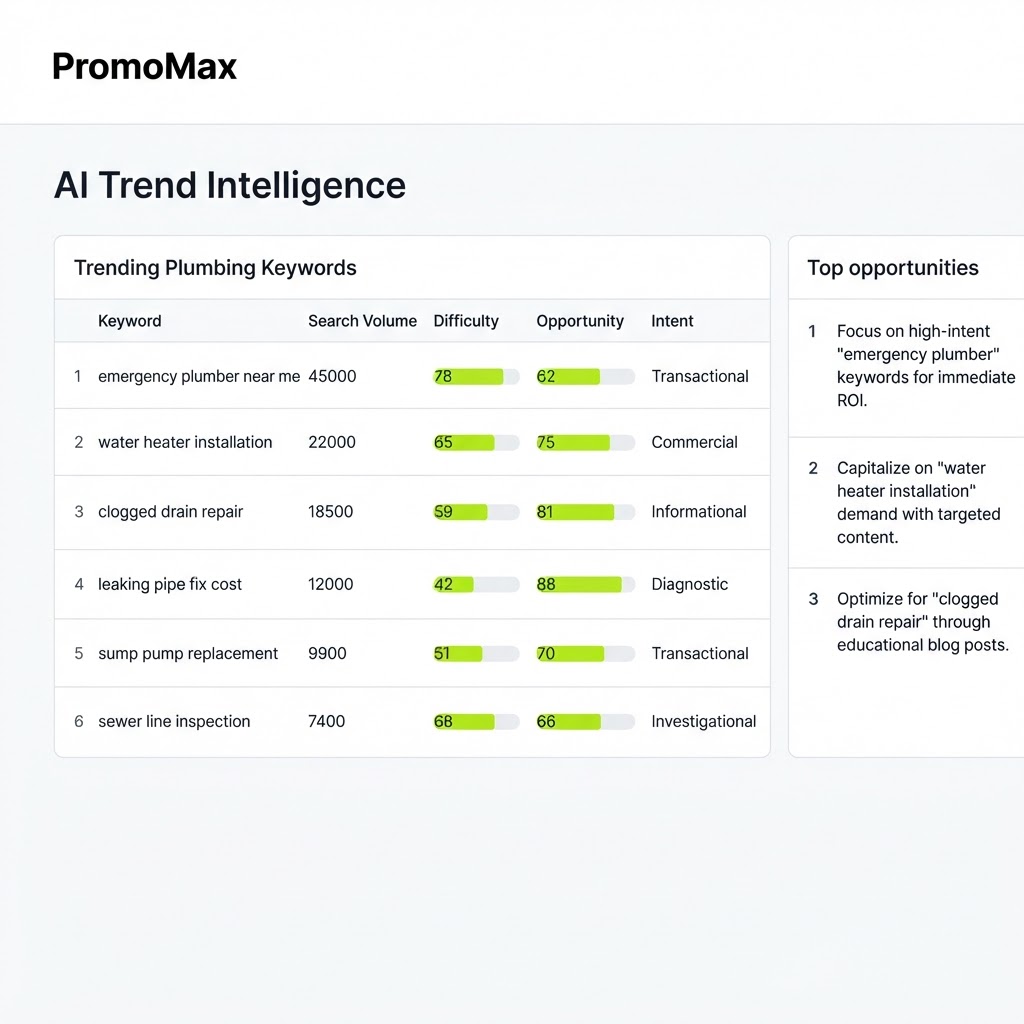
PromoMax builds this research around your business and your area instead of around a national keyword list. You tell it what you do and where you do it, and it scans the searches and questions that surround your services in your market, scoring each one for search demand and buying intent. The result is a ranked topic list you can act on the same day, not a spreadsheet of ten thousand terms you will never touch.
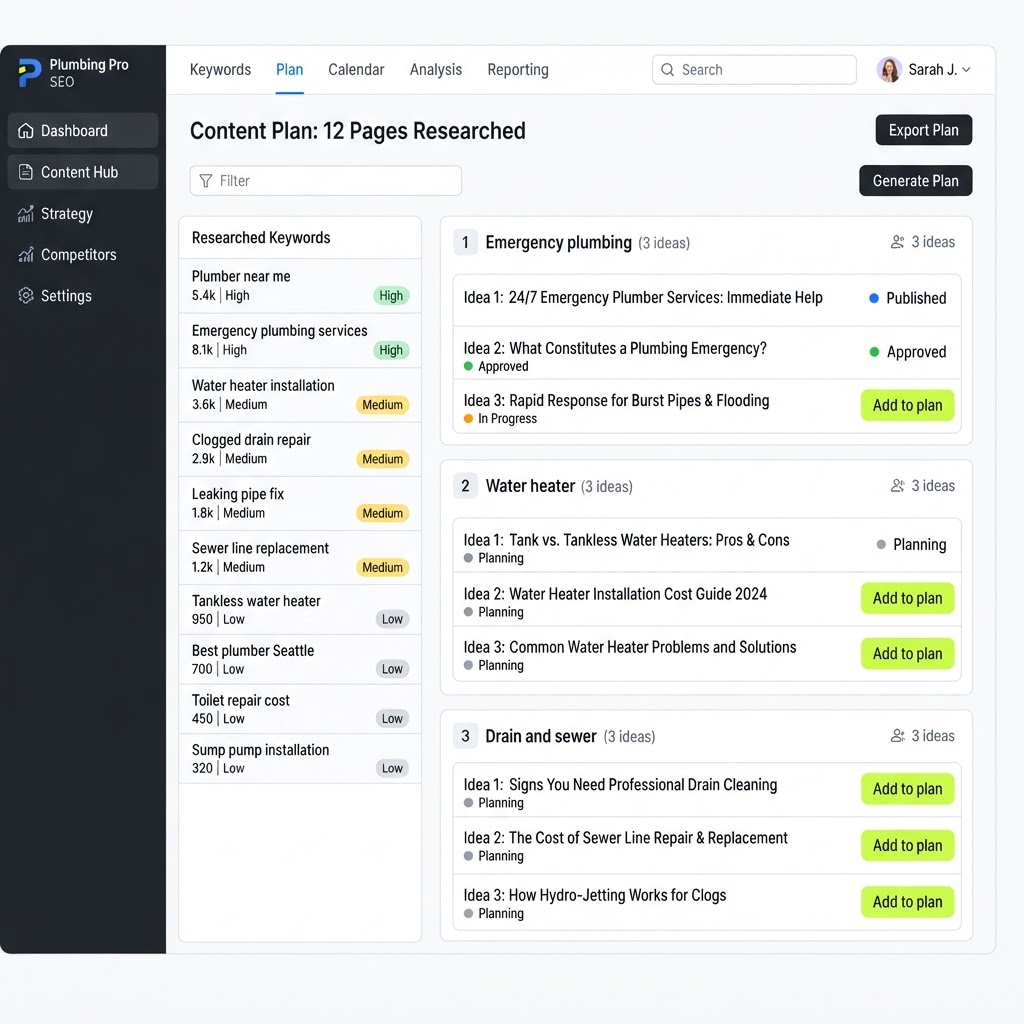
And it does not stop at a list. The topics flow directly into your blog content plan, so the research turns into pages on your website instead of a file you meant to come back to. That connection is the entire point: keywords only make money when something gets written.
What separates a useful list from a long one is intent. A phrase like “water heater repair” is a service search: the person wants someone to do it now. A phrase like “how long does a water heater last” is a research question: the person is deciding whether to call this month or next year. Both belong on a local site, and they belong in different articles, because one reader is ready to book and the other is still deciding whether the problem is worth solving at all.
Inside the tool
A real screen from the Keyword Research Tool for Local Businesses
The problem
The problem: you are guessing at the words customers use
Most local business owners write their website copy about themselves: founded in 2008, family owned, fully insured, customer service first. All true, and none of it matches what a panicking homeowner types at eleven at night. The gap between how you describe your work and how customers search for it is where traffic, calls and bookings quietly disappear.
The professional tools do not help much either. They are built for SEO specialists: difficulty indexes, cost-per-click estimates, filters inside filters. You can spend an evening in one of them and come out with a list of terms and no idea which of them a roofer in a mid-sized city should write about first.
The costliest mistake is chasing volume instead of intent. “Roof repair” might be searched by people researching, comparing and price-shopping, while “roof leaking right now emergency [city]” is searched by somebody about to call. A keyword research tool worth using separates those two, and tells you which topics are worth your limited writing time.
There is also the local part that generic research misses entirely. Customers add their town, their neighborhood, the words “near me”, or the name of the development they live in, and those modifiers change both who is competing and what the right page looks like. A roofer in a metro area is not competing with a national brand for a national term; they are competing with four local companies for “roof repair in [city]”. Research that ignores the area produces topics nobody in your market searches.
How it works
How the keyword research tool finds your keywords
- 1
Enter your business type and your city
You tell the tool what you do and where you work, or connect your website so it can read your services and service areas itself. There is nothing else to configure and no account to set up with a data provider.
If you already use PromoMax for your Google listing, the tool starts from the same business profile, so the research matches the services you actually offer.
- 2
It scans what people actually search around your services
The tool compiles the keywords and the real questions people ask in your market: service phrases, problem phrases, price and timing questions, and the comparisons customers make before they choose. Questions matter as much as keywords, because a question is what someone types when they are deciding.
Each term is scored twice: once for how much search demand sits behind it, and once for buying intent, meaning how close the searcher is to hiring someone. You see both numbers on every row instead of a single unhelpful mystery score.
- 3
You get a ranked list with the noise removed
The list is ordered so the topics worth writing first are at the top: real demand, real intent, and relevant to the services you offer. Junk terms, tool names and searches that do not match your trade are filtered out.
You keep the final say. The tool recommends, you choose, and nothing gets written about a topic you do not want to be known for.
- 4
Chosen topics flow into your content plan
Pick the topics you want, or let autopilot pick from the top of the list, and each one becomes an item in your blog content plan with its target keyword attached. From there the AI blog writer produces the article and publishes it to your website on schedule.
Scans refresh over time, so as your market and your services change, the topic list changes with them instead of going stale after one afternoon of research.
What's inside
What you get from the keyword research
Real keywords and questions
the searches and questions customers use around your trade in your city, not a national list of terms that ignore your area.
Demand and buying-intent scores
a score on every row so you can tell the difference between a topic that gets read and a topic that gets calls.
Competitor topic gaps
see the subjects competitors in your market are already being found for, and the ones nobody has covered well.
A ready-to-use topic list
titles and target keywords your blog can use immediately, instead of research you still have to interpret.
Refreshed scans
topics update as seasons, services and search behavior move, so the plan stays current all year.
Ready when you are
Keyword Research Tool for Local Businesses is already built — it just needs your business connected.
One login runs this tool plus every other tool in the PromoMax system.
Who it is for
Who it is for
It is for plumbers, HVAC companies, roofers, electricians, landscapers, cleaners, salons, dentists, restaurants, contractors, real estate agents, and any local service or product business that wants its website to show up for the words customers actually type.
You do not need any SEO background to use it. If you can answer “what do you do and where do you do it”, the tool can produce a topic list you understand and can act on, and the writing and publishing happen downstream.
One thing worth knowing: the research is a starting point, not a script. You still decide which services you want more of, and a busy owner will often choose one high-intent service topic over ten general ones. The tool ranks the options by demand and intent; the judgement about what your business should be known for stays with you.
Part of the system
Part of a complete marketing system
Keyword research is the map. The rest of PromoMax is the driving: it ranks your Google Business Profile on Google Maps, writes and publishes the articles built from these topics, and builds the signals that get your business mentioned by AI assistants like ChatGPT, Claude, Gemini and Perplexity.
Because the research feeds the writing and the writing feeds your listings, you are not juggling four subscriptions to produce one blog post. It is one system with one business profile at the center.
You also do not have to repeat the research forever. Running the scan again every so often keeps the plan honest as seasons change, as you add services and as you widen your service area. A list built in January is not the list you need in June, and the tool keeps the newest research available for the plan instead of leaving you with a stale document from your first week.
FAQ
Frequently asked questions
What is a keyword research tool?
A keyword research tool finds the phrases and questions people type into Google and ranks them by how much demand sits behind them and how likely the searcher is to buy. A keyword research tool for a local business focuses on your trade and your city rather than on national search volumes you can never compete for.
How is this different from Google Keyword Planner or Semrush?
Those tools are built for SEO professionals and give you raw data to interpret. This one is built for a business owner: it works from your trade and your city, scores every term for buying intent, and hands the topics straight into your blog plan so they get written. You do not need to know what a difficulty index is to use it.
Do I need SEO experience?
No. You need to know what services you sell and where you serve them. The tool turns that into a ranked topic list, and the article writing and publishing are handled for you in the same platform.
Where do the keywords come from?
From real search behavior around your services and your area, combined with what is visible about your business and the businesses you compete with. The tool does not quote a search volume it cannot stand behind; it scores demand and intent so you can prioritize without needing to interpret raw data.
What do I do with the keywords after I find them?
You turn them into pages. Approved topics become blog articles on your website, and the same phrases inform your Google Business Profile description and services. That is how a keyword moves from a list to a customer, and it is why the research in PromoMax is wired directly to the writing.