
You are currently spending far too many hours acting as a manual gatekeeper for your brand's social media presence, a task that often feels like a treadmill with no off switch. By understanding the distinction between AI marketing agents vs static schedulers, you will reclaim your most valuable asset: time. In this guide, you will learn how shifting from a simple publishing calendar to an autonomous growth partner can double your engagement and eliminate the guesswork from your daily promotional efforts.
Short on time? Enter your website and see what it would write for your business — free, in about 30 seconds.
The Core Divide: AI Marketing Agents vs Static Schedulers
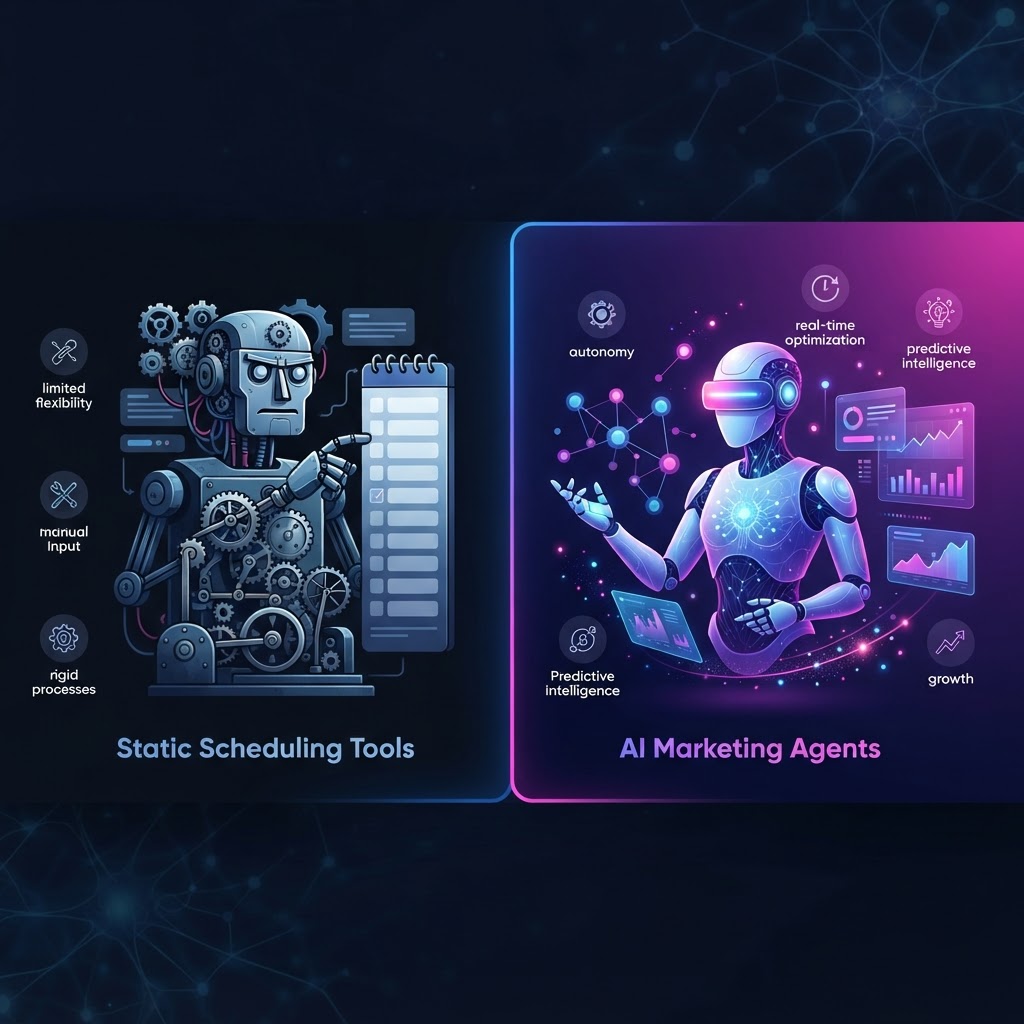
To appreciate the leap in technology, you must first recognize the fundamental limitations of traditional tools. Static schedulers are strictly reactive, functioning as digital calendars that execute commands without context. If you schedule a post about a summer sale on a Tuesday at 10 AM, the tool will post it even if a sudden industry crisis makes your tone seem insensitive or if market interest has shifted entirely. It lacks the peripheral vision required for modern commerce.
Conversely, AI marketing agents represent a shift from execution to strategy. These agents act as an autonomous extension of your team. They do not just post content; they interpret performance data from your previous campaigns and adjust future efforts to match. Where a static tool needs you to tell it what to do, an AI agent asks you what your goals are and then maps the path to achieve them. This is the difference between having a hammer and having a carpenter.
Why Autonomous Marketing Agents are the Future for SMBs
Small business owners are often pulled in a dozen directions at once, from operations to accounting. Autonomous marketing agents for SMBs solve the bandwidth crisis by managing the always-on nature of digital platforms. When you rely on a manual workflow, your presence often becomes inconsistent during busy operational periods. An autonomous agent ensures that even when you are focused on a client meeting or supply chain issues, your brand continues to engage with your audience, capture leads, and maintain community trust.
- Self-optimization: The agent learns which hashtags, image styles, and hooks perform best for your specific audience.
- Reactive growth: Agents can identify spikes in trending topics and draft relevant posts to capitalize on them before the trend fades.
- Consistent presence: Your brand stays in front of customers regardless of your personal schedule.
Practical Benefits of Agent-Based Marketing
The transition toward agent-based marketing yields measurable improvements in how your business interacts with the world. A major pitfall of manual scheduling is brand drift, where content becomes repetitive or robotic because the business owner is rushing to fill a queue. AI agents maintain a consistent brand voice while ensuring that every piece of content serves a strategic purpose. By automating the feedback loop, your social media management becomes a living system that improves with every interaction.
Common mistakes in traditional scheduling include batching content without verifying market relevance or ignoring cross-channel nuances. An agent avoids these errors by treating every platform as a unique environment, optimizing captions for the professional tone of LinkedIn or the visual, fast-paced nature of Instagram automatically.
Steps to Transitioning Your Workflow
- Perform a time-waste audit: Track your marketing tasks for one week. You will likely find that 70 percent of your effort is spent on administrative tasks like resizing files or formatting captions.
- Select a pilot platform: Choose the social channel where you currently have the most engagement and hand over the publishing duties to an AI agent.
- Review the data: Compare the engagement metrics from the agent-led period against your previous manual results.
- Scale your autonomy: Once comfortable, empower the agent to handle cross-channel distribution and basic community responses.
Frequently Asked Questions
Do AI agents replace the need for a marketing strategy?
No. An agent is a high-performance engine, but you are still the driver. The agent executes your strategy with precision, but it still requires your high-level direction regarding promotions, seasonality, and core business goals.
Is it difficult to integrate AI agents into an existing business?
Modern platforms like PromoMax are built for simplicity. You do not need a degree in data science to deploy these tools; most systems are designed to integrate with your existing brand assets in minutes.
Do AI agents handle content creation too?
Yes. These agents move beyond simple scheduling by drafting, editing, and optimizing copy. They handle the heavy lifting of content generation, leaving you to simply review and approve the final output.
How do I ensure the AI stays on brand?
By defining your preferences in an automated brand voice guide, you provide the agent with a blueprint for your tone, vocabulary, and stylistic constraints. The AI will strictly follow these parameters to ensure every post sounds like you.
Related Reading
- The Rise of Autonomous Marketing: How AI Agents Manage Day-to-Day Operations
- AI Content Governance: Ensuring Brand Consistency in Automated Posts
- What is AI Social Media automation and how does it actually save time?
See what it writes for YOUR business
Go to promomax.ai right now, enter your website, and get custom posts written for your business in about 30 seconds — free, no credit card. That's hundreds of posts a month on autopilot, written in your voice, published while you run your business. 7-day money-back guarantee, cancel anytime.
Get my free posts