
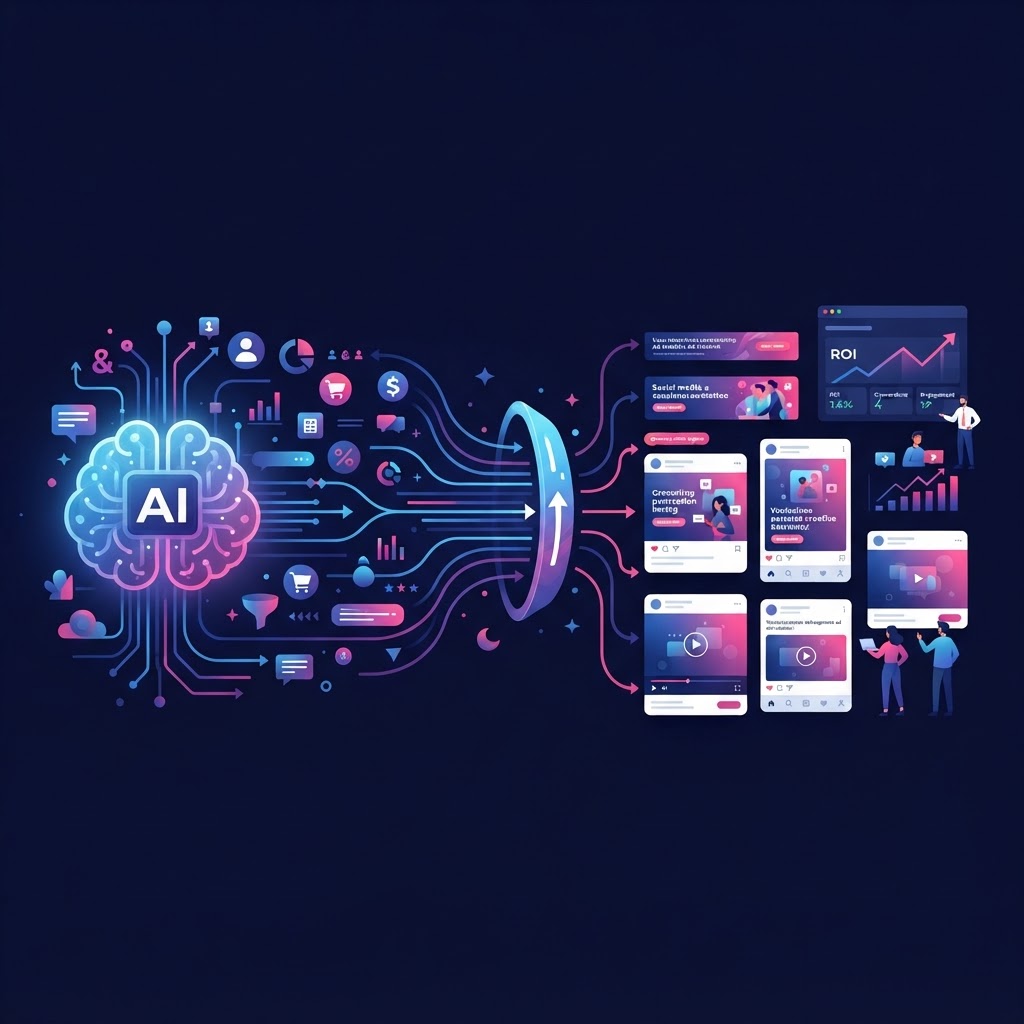
You are likely tired of burning your marketing budget on generic advertisements that fail to convert, but AI-driven customer insights offer a practical way to make your ad creative more relevant. By using machine learning to analyze audience behavior, you can build ad creative that speaks more directly to your target market — then measure whether it helps lower your customer acquisition costs and improve your return on ad spend.
Short on time? Enter your website and see what it would write for your business — free, in about 30 seconds.
How Do AI-Driven Customer Insights Actually Improve Ad Performance?
Traditional advertising campaigns often suffer from reliance on broad, static demographics. In contrast, AI systems process granular data points—such as dwell time on landing pages, previous purchase cycles, and interaction history—to reveal the intent behind a click. By integrating these AI-driven customer insights directly into your creative brief, you shift from guessing what might work to deploying messaging backed by evidence. Instead of a one-size-fits-all approach, your brand can now offer a customized experience where an ad feels like a direct recommendation rather than a broad-spectrum solicitation.
The Multi-Layered Impact of Personalized Ad Creative
Personalization has evolved far beyond simply using a prospect's name in a subject line. It now encompasses dynamic adjustments to visual aesthetics, emotional tone, and value propositions. AI marketing analytics can help you compare which visual elements—such as high-contrast photography versus minimalist lifestyle shots—correlate with higher click-through rates for specific audience segments. Organic analytics reveal which messages, formats and audience segments earn the most attention, and that intelligence directly informs your paid targeting and creative decisions.
The components of AI-enhanced creative include:
- Visual Preference Mapping: Determining whether your audience responds better to human-centric imagery or abstract product feature highlights.
- Tone Calibration: Adjusting the copy structure to mirror the specific pain points identified in your behavioral data.
- Offer Personalization: Presenting a discount to price-sensitive leads versus highlighting exclusive VIP benefits to loyal customers.
How to Implement Data-Backed Creative Strategies
To begin, you must stop viewing your ad sets as isolated experiments and start treating them as a continuous data-collection loop. Follow these specific steps to get started:
- Audit Historical Wins: Review your recent ad performance history. Identify your top-performing ads and look for patterns. Are they video, carousel, or static images? Note the specific language patterns they share.
- Establish a Creative Baseline: Document the core elements that repeat in your successful ads. Use these as your control set.
- Scale Through AI Testing: Utilize AI marketing platforms to generate multiple creative variations based on your winning patterns, then compare their performance to see whether they reduce manual design work for your team.
Avoiding Common Pitfalls
One common mistake is over-automating without oversight. AI is a tool, not a pilot. Even with advanced software, you must ensure that the output remains aligned with your core business identity. A secondary mistake is failing to segment your data properly. If you treat a brand-new prospect the same as a churned customer, your ads will sound discordant. Always segment by lifecycle stage to maintain relevance.
Putting It Into Practice
Start your transition to AI-supported marketing by dividing your audience into three buckets: prospects who need education, active users who need product updates, and churned customers who need re-engagement incentives. Use AI to generate copy and visuals that address these specific life stages, then use social media management platforms to deploy them, checking performance metrics regularly so you can adjust your content as needed.
Frequently Asked Questions
What are the primary benefits of AI-driven creative?
Rather than promising fixed results, focus on what you can actually measure. Important ad metrics to track include total ad spend, clicks, click-through rate, cost-per-click, cost-per-engagement, cost-per-action, and conversion rate. Comparing these numbers before and after applying AI-driven insights can show whether your creative changes are reducing wasted spend or speeding up your testing cycle.
Can AI replace the need for a creative team?
AI does not replace human ingenuity; rather, it augments it. It handles the data-heavy analysis and repetitive production tasks, freeing up your team to focus on high-level strategy and emotional storytelling.
How does AI ensure my brand voice stays consistent?
Modern platforms may let you upload your brand style guide, tone-of-voice documentation, and visual assets as a reference layer. Check whether your platform supports this, and review AI-generated variations to confirm they still match your brand voice.
Is this technology suitable for very small businesses?
Possibly. For small teams, tools like small business marketing automation can help you manage more campaigns with limited staff. Compare specific features—such as targeting options and reporting—against your budget to see whether they help you spend more efficiently, and track your own metrics over time to confirm the impact for your business.
Related Reading
- PromoMax vs HubSpot: Choosing the Right Automation for SMBs
- How to Automate Social Media for small business to save time
- How to use AI for Social Media content creation without sounding robotic
See what it writes for YOUR business
Go to promomax.ai right now, enter your website, and get custom posts written for your business in about 30 seconds — free, no credit card. That's hundreds of posts a month on autopilot, written in your voice, published while you run your business. 7-day money-back guarantee, cancel anytime.
Get my free posts