
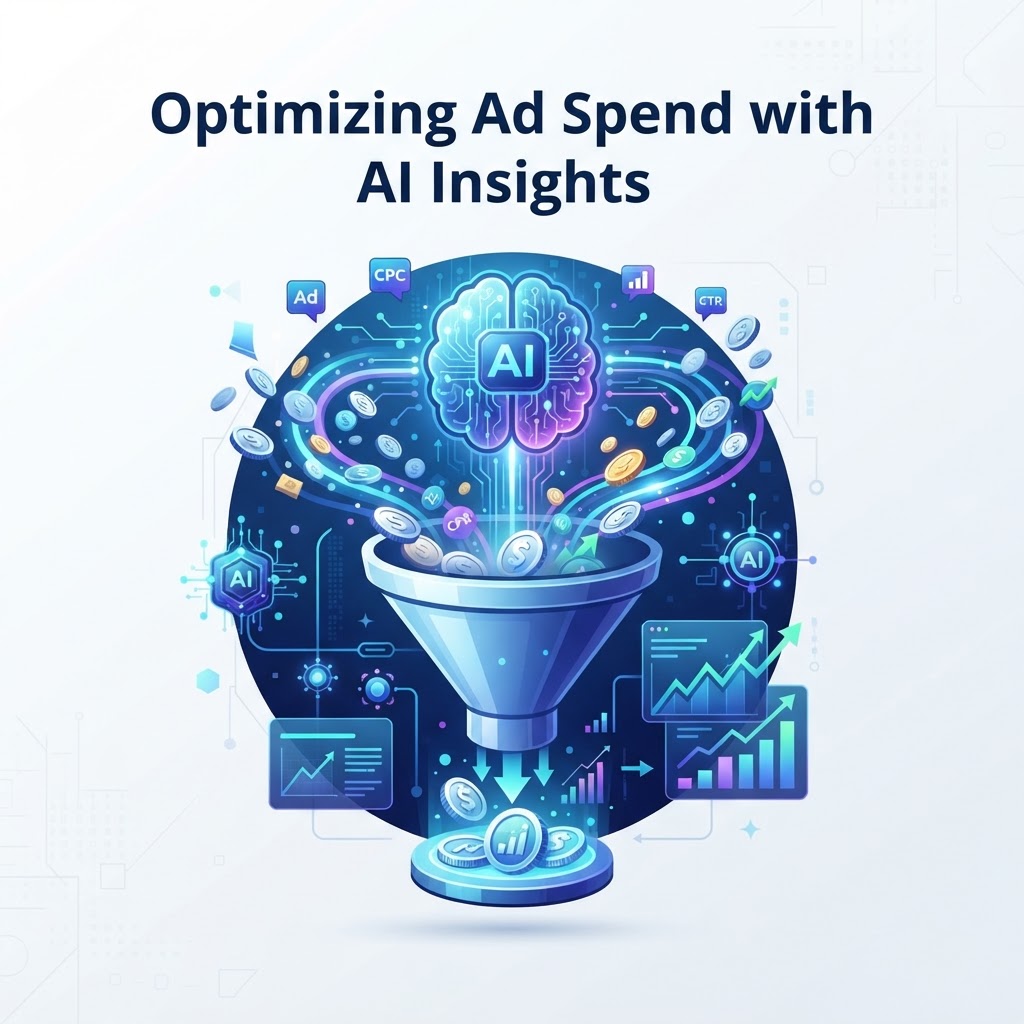
If you are tired of watching your marketing budget vanish into ineffective clicks, it is time to shift your strategy toward data-driven precision. By learning how to optimize ad spend with AI, you will transform your advertising from a guessing game into a reliable engine for growth that prioritizes high-value customer acquisition over vanity metrics.
Short on time? Enter your website and see what our AI would write for your business — free, in about 30 seconds.
Understanding the AI Advantage in PPC
Manual campaign management is fundamentally flawed because it relies on human observation to catch trends that have already passed. AI-driven advertising moves beyond simple set-it-and-forget-it rules by utilizing machine learning algorithms that process millions of data points simultaneously. From granular user behavior patterns and time-of-day engagement to complex historical conversion rates, AI models make split-second bid adjustments that no human could replicate. This level of precision, known as AI PPC automation, allows you to reduce marketing waste by ruthlessly cutting non-performing keywords and audiences before they drain your daily budget.
The Core Pillars to Optimize Ad Spend with AI
To successfully optimize ad spend with AI, you must move beyond the basics and focus on three structural pillars: data integrity, rapid testing cycles, and predictive bidding intelligence.
1. Consolidate Your Data Architecture
AI systems are only as smart as the data they consume. If your ad platform only tracks clicks, your AI is optimizing for curiosity rather than revenue. You must integrate your CRM with your ad platforms so the AI can distinguish between a casual visitor, a qualified lead, and a completed sale. A common mistake is allowing algorithms to optimize for cost-per-click. Instead, ensure your setup feeds conversion value data back to the machine. When the AI knows which users represent a high lifetime value, it learns to hunt for similar audience profiles, effectively multiplying your return on investment.
2. Implement Rapid Multi-Variate Testing
Manually testing ten ad variants takes weeks of stagnant performance. AI tools facilitate rapid multi-variate testing, which executes experiments across headlines, images, calls-to-action, and audience segments simultaneously. This allows you to identify winning combinations in days rather than months. The goal is to reach statistical significance quickly. By rotating creatives automatically based on real-time engagement, AI prevents ad fatigue and ensures your messaging remains resonant with the specific audience segment seeing it at that exact moment.
3. Leverage Predictive Bidding Models
Predictive models identify high-intent users by analyzing behavioral signals that precede a purchase. Instead of bidding a flat, inefficient amount for every impression, AI directs your spend toward users whose digital footprints suggest they are at the bottom of the sales funnel. For instance, an AI might increase your bid by 40% for a user who has visited your pricing page twice but decreased it for a user who bounced after three seconds. By shifting your budget toward these high-probability conversions, you naturally lower your acquisition cost.
Strategic Execution: A Practical Framework
Start your transition by conducting a deep audit of your last 90 days of performance. You will likely find that a small fraction of your campaigns accounts for the majority of your success. Follow this checklist to refine your approach:
- Identify the 80/20 Split: Locate the top 20% of your campaigns that generate 80% of your revenue.
- Analyze Winning Signals: Use an AI marketing agent to parse these campaigns and identify commonalities in geography, device type, and peak interaction times.
- Redeploy Budget: Apply these winning signals to your underperforming campaigns. If a segment does not show improvement after a 14-day observation period, pause it and reallocate that budget to your proven high-performers.
Common pitfalls often involve being too impatient or too cautious with data thresholds. Avoid making changes every 24 hours, as this disrupts the machine learning learning phase. Give the algorithms enough runway to optimize your bids based on actual conversion data. By combining these tactical adjustments with consistent AI monitoring, you create a scalable system that automatically weeds out waste and drives profitable growth.
Related Reading
See what it writes for YOUR business
Go to promomax.ai right now, enter your website, and get custom posts written for your business in about 30 seconds — free, no credit card. That's hundreds of posts a month on autopilot, written in your voice, published while you run your business. 7-day money-back guarantee, cancel anytime.
Get my free posts