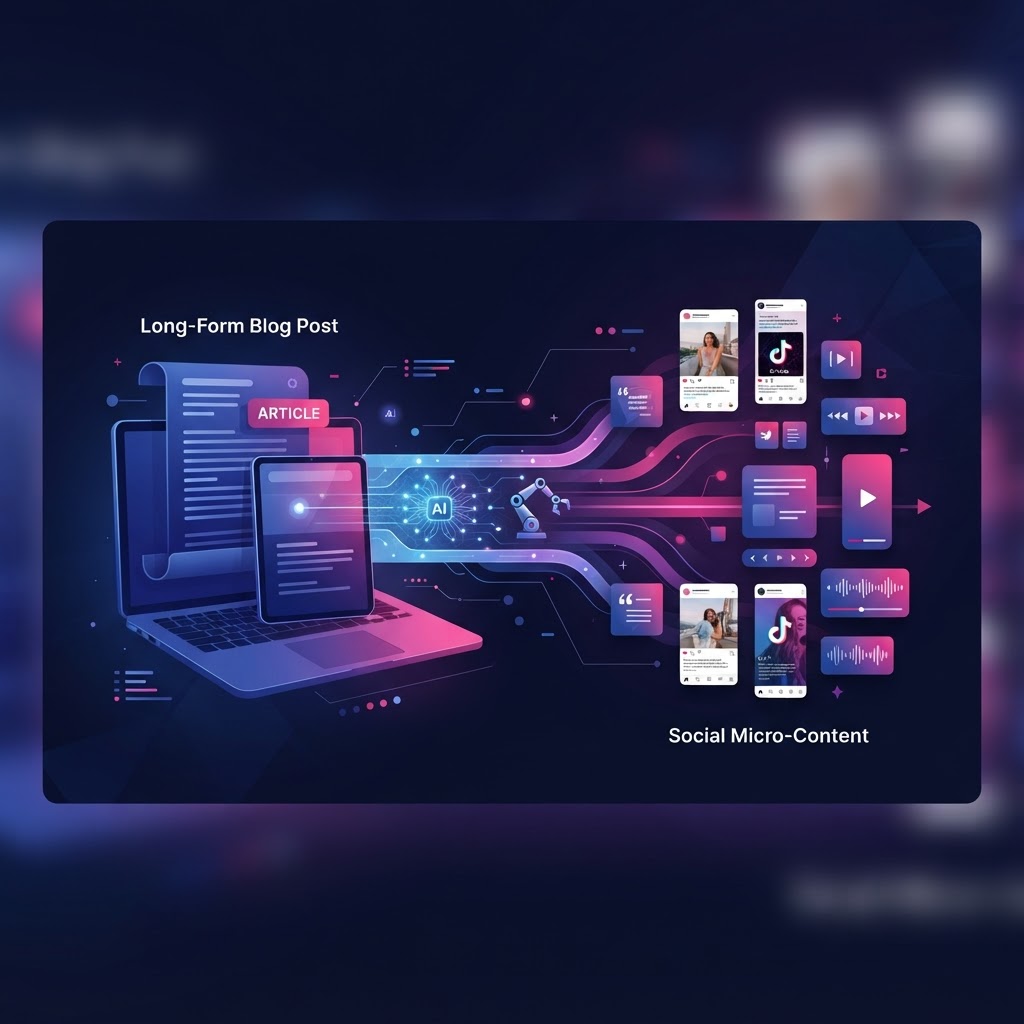

You are likely tired of scrolling through social media feeds and blog posts that all sound exactly the same, and your audience is feeling that exhaustion too. In this guide, you will learn the exact strategies for avoiding AI content fatigue, helping you maintain a sharp, human-centric brand identity that actually converts readers into loyal customers.
Short on time? Enter your website and see what it would write for your business — free, in about 30 seconds.
Why Does AI Output Feel Repetitive?
AI models are trained to predict the most statistically probable next word in a sequence. By design, they seek the middle ground of human language. When you provide generic prompts, the model defaults to the average of its massive training set, which manifests as bland adjectives, repetitive sentence structures, and a lack of specific industry nuance. If you use the same prompt structure every week, your output will inevitably feel like a recycled echo chamber.
Audiences today possess a high degree of digital intuition. They can detect the mechanical rhythm of AI-generated prose, which often leads to reduced engagement and a subtle erosion of brand trust. If your content feels like it was written by a robot, your audience will treat it like an advertisement rather than a conversation.
How to Implement Dynamic Content Strategies
To move beyond the 'gray' zone of predictable content, you must treat your AI tools as an extension of your team rather than an automatic writer. Here is how you can break the cycle:
- Style Priming: Before you ask for a full article, paste three of your best-performing, human-written emails or blog posts. Use a prompt like: 'Analyze the syntax, sentence length variation, and vocabulary used in these examples, then adopt this specific persona for the following task.'
- Roleplay Parameters: Instead of asking for 'a post about marketing,' ask the AI to write as 'an empathetic small business consultant who values plain language over corporate jargon.'
- Constraint Rotation: Force the AI out of its default mode by imposing strict limits. Ask for zero adjectives, or require that every sentence starts with a different letter.
Effective AI Text Variation Techniques
You can manipulate the underlying mechanics of large language models to increase variety. If you are using platforms that offer advanced settings, look for the 'Temperature' dial. A setting closer to 0.7 or 0.8 introduces a higher degree of randomness into word choice, making the final output feel more creative and less formulaic. If your interface does not allow for temperature settings, you can achieve this by adding instructions like 'Use unexpected metaphors' or 'Avoid industry cliches like game-changer or synergetic.'
Furthermore, use 'Chain-of-Thought' prompting. Ask the AI to draft a detailed outline, provide two alternative angles on the topic, and identify the most controversial viewpoint before it writes a single paragraph. This forces the model to process logic before it defaults to its predictable linguistic patterns.
Putting It Into Practice: The Modular Workflow
Stop generating posts in isolation. Instead, use a social media content creation framework that treats every piece of content as part of a structured ecosystem. Map your themes for a 30-day cycle and use a 'content seed' strategy.
- Collect raw data: Gather internal notes, client feedback, or recent news in your industry.
- Define the goal: State exactly what you want the reader to feel or do after consuming the post.
- Feed the seed: Input these specifics into your prompt to ground the AI in reality rather than generalities.
Frequently Asked Questions
How often should I refresh my AI prompts?
You should review and update your baseline prompts at least once every quarter or whenever your business goals pivot. Stale prompts lead to stagnant results, so treat your prompt library like a living brand guideline document.
Can AI really mimic a unique human voice?
Yes, but it requires input. The AI cannot mimic you if you do not feed it your unique vocabulary, your specific pet peeves about the industry, and your personal stories. The more context you provide about your 'why,' the less the AI sounds like a machine.
Will using AI hurt my search engine rankings?
Search engines prioritize helpful, high-quality content that satisfies user intent. They do not penalize content for being AI-assisted as long as it provides original value, accurate information, and a perspective that cannot be found on a generic search result page.
What is the most common mistake in AI content?
The most common error is providing 'zero-context' prompts. When you give the AI no specific audience profile, no brand history, and no clear objective, you are forcing the model to guess. The result is always generic filler that fails to build a real connection with your customer base.
Related Reading
- Creating an AI-Automated Brand Voice Style Guide
- AI Content Governance: Ensuring Brand Consistency in Automated Posts
- How do I use AI to create a full month of Social Media content in one day?
See what it writes for YOUR business
Go to promomax.ai right now, enter your website, and get custom posts written for your business in about 30 seconds — free, no credit card. That's hundreds of posts a month on autopilot, written in your voice, published while you run your business. 7-day money-back guarantee, cancel anytime.
Get my free posts