
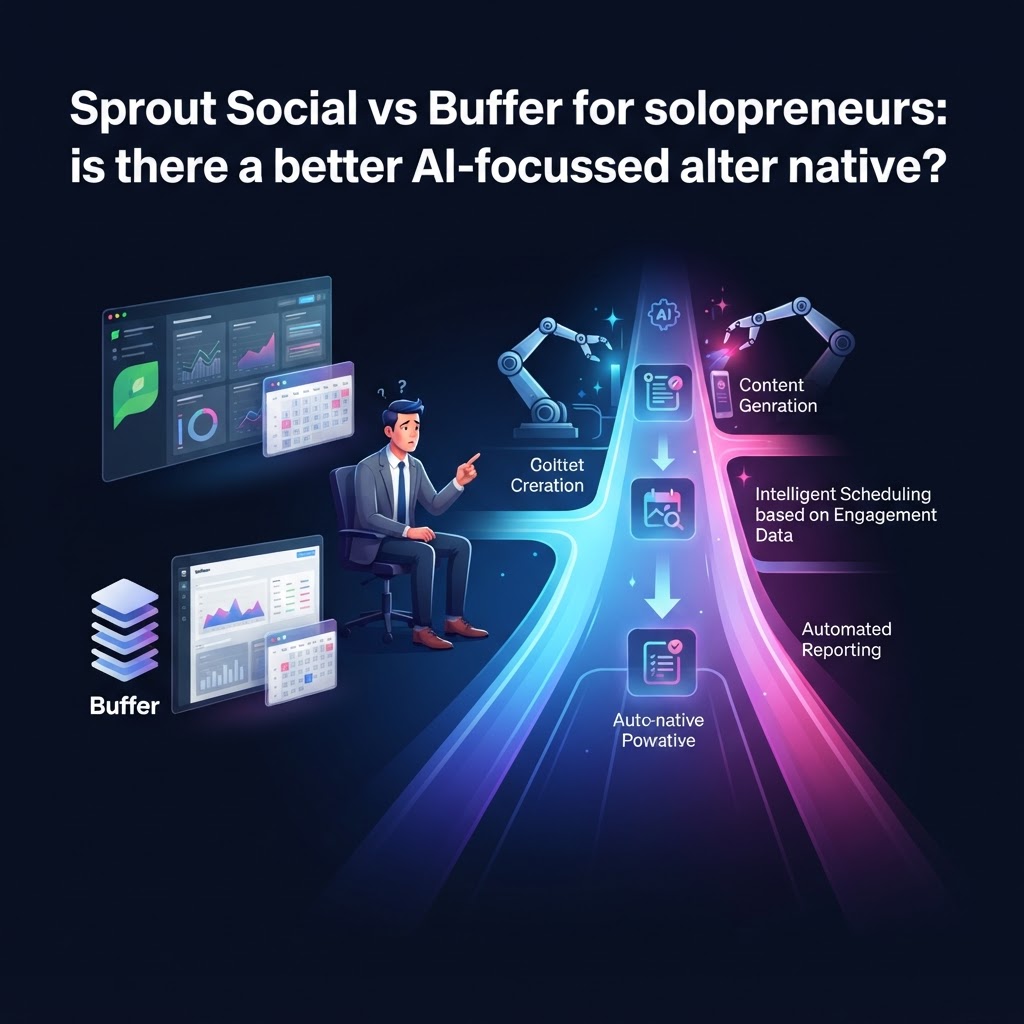
If you are a solopreneur, your time is your most valuable currency, and deciding between Sprout Social vs Buffer for solopreneurs is often a trade-off between simplicity and depth. You likely want a system that helps you grow your audience without requiring hours of manual input. Buffer provides a straightforward interface for scheduling, and Sprout Social offers analytics features aimed at larger organizations. Before committing to either, list the specific tasks you want automated each week and test how each platform, including any AI-native alternatives, handles them so you can see which actually reduces your manual workload.
Short on time? Enter your website and see what it would write for your business — free, in about 30 seconds.
Understanding the Limitations of Legacy Tools
When evaluating the ongoing debate regarding Sprout Social vs Buffer for solopreneurs, you have to consider the fundamental architecture of these tools. Buffer functions primarily as a scheduling calendar: it succeeds at being a calendar, but it remains a passive tool. You must provide the ideas, the copy, and the images. If you do not feed the machine, it produces nothing. Before choosing either tool, list out which parts of your workflow—idea generation, copywriting, image creation, or scheduling—you actually need automated, and test each platform against that specific list.
Sprout Social, on the other hand, is built for the corporate ecosystem. Sprout Social is an AI-powered Social Intelligence platform that offers deep insights with social media listening. For a solo business owner, it's worth checking whether the price point matches features you'll actually use day to day. Compare your required feature list against each plan's tier and confirm you are not paying for capabilities built for multi-account agencies.
Comparative Analysis Table
| Feature | Buffer | Sprout Social | PromoMax |
|---|---|---|---|
| AI Content Creation | Check current AI drafting features on their site | Review AI Assist features included in each plan tier | Compare automated content generation features directly |
| Pricing Model | Compare free and paid tiers on their pricing page | Check per-seat pricing tiers, including Enterprise | Review current plan options and what's included |
| Target User | Beginner Solopreneur | Corporate/Agency | Growth-Focused Small Business |
| Automation Depth | Confirm what scheduling automation is currently offered | Check which listening and reporting tasks are automated | Ask what agent-based automation is currently available |
Why Solopreneurs Must Transition Beyond Scheduling
Managing social media manually is a common mistake that keeps many solopreneurs stuck in the grind. Even with the best social media scheduling tool, you are still responsible for constant trend adaptation and high-quality creative output. A schedule is not a strategy. If you rely only on a calendar, you are missing out on the compounding benefits of an ai marketing team that works while you sleep.
Consider these three ways a modern AI-native tool changes your workflow:
- Proactive Content Generation: Instead of staring at a blank screen, you use automated content creation that pulls from your website content to generate relevant, on-brand posts.
- Contextual Awareness: Modern agents understand your specific industry niche and target audience demographics, ensuring that your messaging remains consistent across platforms.
- Continuous Engagement: If you use ai agents for small business, track how quickly initial inquiries are acknowledged and whether follow-up nurturing sequences convert into leads, then adjust the workflow based on that data.
Implementing a Modern AI Marketing Strategy
To move from a manual workflow to an AI-driven one, start by auditing how you currently handle your small business marketing. Try tracking how many hours a week you spend writing captions; even a modest weekly time cost adds up over a year and could be redirected toward product development or high-level client strategy. An effective ai post generator should do more than just write text; it should integrate directly with your growth goals. Stop thinking about posting for the sake of activity and start thinking about posting for the sake of conversion.
Frequently Asked Questions
Is Sprout Social too expensive for a solopreneur?
Sprout Social's pricing is structured per seat and scales with your needs. Sprout Social offers tiered per-seat pricing, with Standard starting at $199 per seat per month, scaling up to custom Enterprise plans for large-scale operations. For a solo business, it's worth comparing the seat cost against how much you'd actually use features like deep-level social listening before committing.
Does Buffer offer enough AI features?
Buffer includes some AI-assisted tools for drafting captions and ideas; check its current feature list to see whether it offers the deeper, brand-aware automation you'd need for a more hands-off marketing strategy.
What is the biggest benefit of an AI-native tool?
Look for an AI-native tool that can draft content, suggest optimal posting times, and support engagement management, then test these features yourself to see how well they scale with your growth.
Can I replace my entire marketing team with AI?
For solopreneurs, many routine social media tasks can be automated; try measuring how much time this frees up for you so you can focus your energy on high-level strategy and client relations.
Related Reading
- Hootsuite vs Buffer vs PromoMax: which is best for a small business?
- How do I use AI to create a full month of Social Media content in one day?
- How to Automate Multi-Channel Marketing Without a Dedicated Content Team
- The ROI of Switching from Manual Marketing to AI-Powered Automation
See what it writes for YOUR business
Go to promomax.ai right now, enter your website, and get custom posts written for your business in about 30 seconds — free, no credit card. That's hundreds of posts a month on autopilot, written in your voice, published while you run your business. 7-day money-back guarantee, cancel anytime.
Get my free posts