
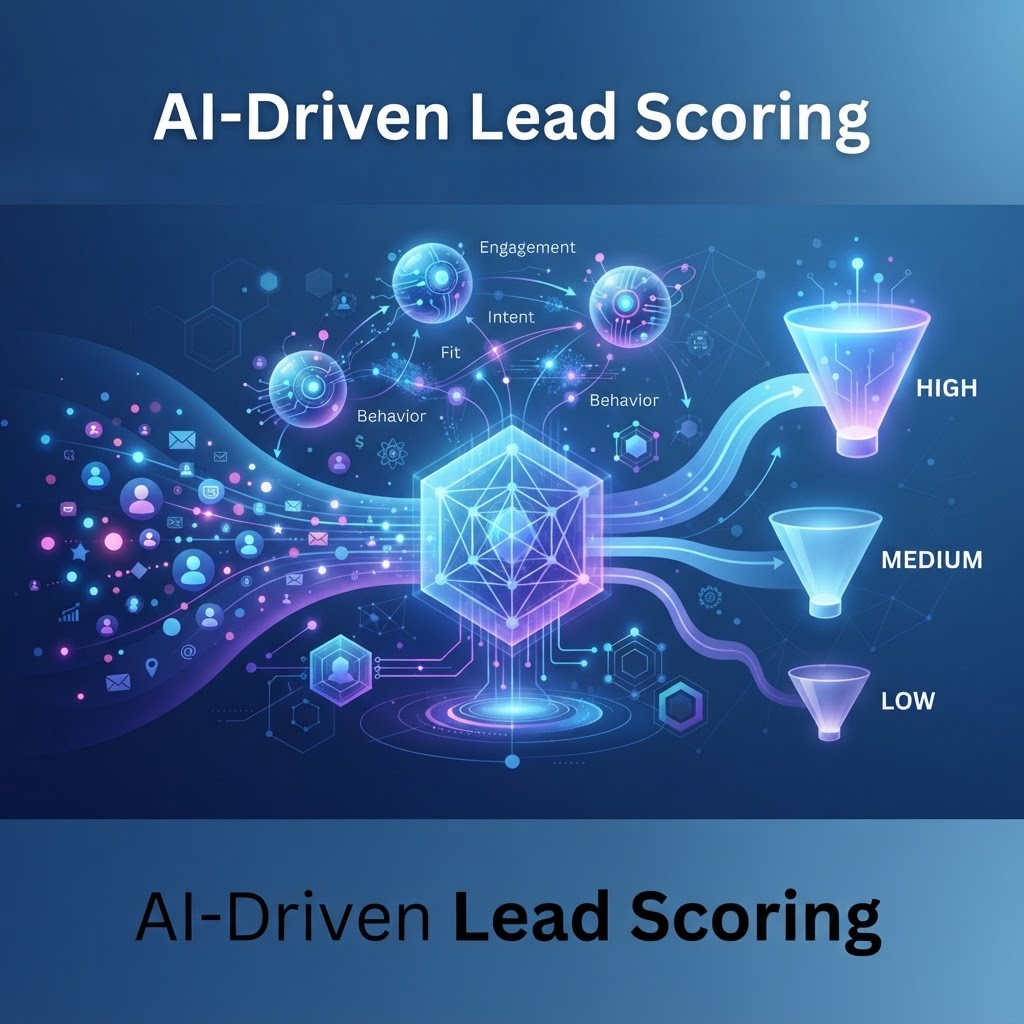
If you have ever felt like your sales team is spinning their wheels chasing dead-end leads while high-value prospects slip through the cracks, you are not alone. Transitioning to AI lead scoring for small business operations provides the precision you need to stop guessing and start closing deals with confidence. By the end of this guide, you will understand how to leverage data to transform your sales pipeline into a predictable revenue engine.
Short on time? Enter your website and see what it would write for your business for free in about thirty seconds.
What is AI Lead Scoring?
At its core, AI lead scoring is a sophisticated method of using machine learning algorithms to assign a numeric value to every potential customer in your database. Unlike traditional, rules-based systems where you might manually award ten points for a website visit and fifty points for a webinar registration, AI models process vast amounts of historical data to uncover hidden patterns. These systems analyze thousands of engagement signals simultaneously, including granular metrics like the specific path a user takes through your site, email click-through behaviors, and firmographic data like company size or industry relevance.
The AI essentially learns what a customer who actually converts looks like for your specific business. It distinguishes between a high-intent lead who is ready to buy and a casual visitor who is merely browsing for information. By filtering out the noise, you ensure that your sales team is not wasting energy on prospects who have zero intention of signing a contract.
Why Small Businesses Need Predictive Lead Qualification
For a small business owner, time is your most valuable currency. You often lack the massive sales departments that enterprise companies use to manually qualify every lead that hits the inbox. Predictive lead qualification bridges this gap by acting as a force multiplier for your existing team. Here are the primary reasons why adoption is critical for scaling:
- Eliminating Human Bias: Sales reps often prioritize leads based on gut feeling or recency, but AI remains objective by focusing strictly on data-driven conversion indicators.
- Maximizing Team Productivity: When your team knows exactly who to call, they spend more time selling and less time digging through spreadsheets to find the next lead.
- Reducing Acquisition Costs: By focusing your outreach efforts only on high-scoring prospects, you optimize your ad spend and decrease the cost per acquisition over time.
How It Works in Practice
Implementing AI lead scoring for small business growth is a three-step process that relies on clean, accessible data. Without a solid foundation, the algorithms cannot function effectively.
1. Consolidate Your Data Sources
Your CRM, email marketing platform, and website analytics must feed into a unified ecosystem. If your data is siloed, the AI will only have a partial view of the customer journey. You need a 360-degree look at how a lead interacts with your brand from their first visit to their final purchase.
2. Establish Historical Baselines
Provide the system with data on your past wins and losses. By reviewing the last twelve months of your sales records, the AI identifies common characteristics of your best customers. It might find, for instance, that people who visit your case study page three times before signing up are three times more likely to convert than those who go straight to the checkout page.
3. Automated Real-Time Scoring
Once the model is trained, it will automatically score new incoming leads the moment they register on your site. This allows your team to reach out when the lead is at their peak interest level, which significantly improves the probability of starting a productive conversation.
Common Mistakes to Avoid
Even with the best tools, small businesses often stumble during implementation. One frequent mistake is over-complicating the scoring model too early. Start with a simple model that identifies the top 20% of your leads based on clear indicators, and then refine it as you collect more data. Another error is failing to maintain the feedback loop between sales and marketing. If your sales team finds that leads with high AI scores are not actually closing, you must feed that information back into the algorithm to recalibrate the model. Remember that AI is a tool to support human decision-making, not a total replacement for the intuition and relationship-building skills your team brings to every sales call.
Related Reading
See what it writes for YOUR business
Go to promomax.ai right now, enter your website, and get custom posts written for your business in about 30 seconds — free, no credit card. That's hundreds of posts a month on autopilot, written in your voice, published while you run your business. 7-day money-back guarantee, cancel anytime.
Get my free posts