
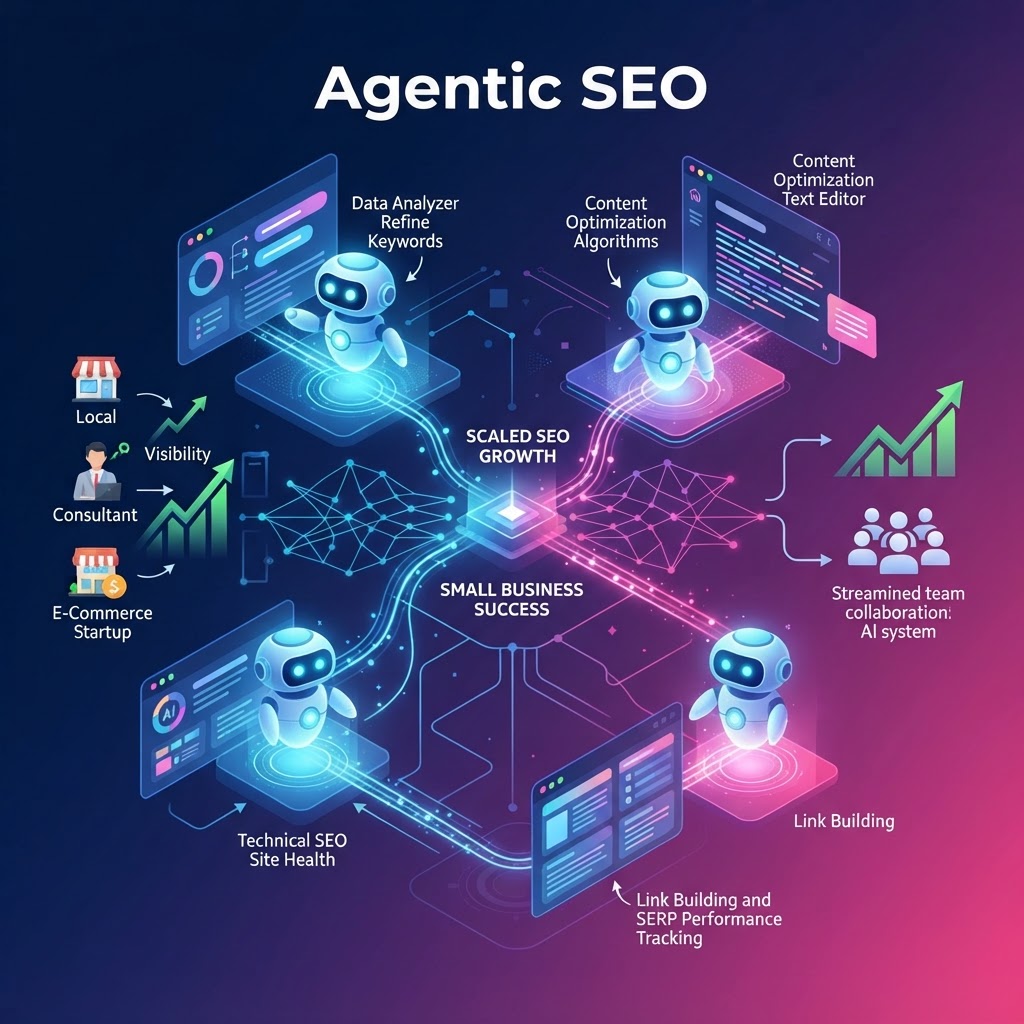
You are likely balancing a dozen different tasks today, and SEO often feels like an impossible hurdle to clear while running your company. Agentic SEO represents a fundamental shift in how you can reclaim your time while ensuring your website remains a powerhouse for customer acquisition. By leveraging autonomous systems, you can move away from manual labor and toward a growth engine that works while you sleep, providing you with sustainable search rankings and reliable traffic.
Short on time? Enter your website and see what it would write for your business — free, in about 30 seconds.
The Fundamental Shift to Agentic SEO
Traditional SEO is inherently manual and reactionary. In the old model, you or your marketing hire must manually pull reports from search consoles, interpret that data, brainstorm topics, write drafts, and push updates to your site. This process is prone to human error and long delays. Agentic SEO changes the paradigm by utilizing AI agents that function as a digital workforce. These agents are not just static chatbots; they are systems capable of reasoning, planning, and executing tasks within a feedback loop. Instead of simply providing information, an agent can identify that a page has dropped three positions for a key term, conduct a competitor analysis, rewrite the H2 headings to include missing semantic keywords, and alert you once the deployment is complete.
Why Small Businesses are Adopting Autonomous Workflows
The primary advantage for your business is consistency. SEO is a game of marginal gains that requires steady, long-term effort. When you treat SEO as a monthly project, your results will suffer from the gaps between your manual efforts. AI marketing agents ensure that technical health checks, backlink monitoring, and content updates occur consistently. By offloading these high-frequency, repetitive tasks, you ensure that your site never goes stale. You are effectively hiring a round-the-clock digital strategist that operates at a fraction of the cost of a full-time employee.
Key Components of a Modern Agentic Strategy
To build a system that moves the needle, you must approach your digital presence as a series of interconnected automated tasks. Successful implementation relies on four foundational pillars:
- Goal Definition: Define your core conversion pages. Your agents should focus primarily on the keywords that drive revenue rather than vanity metrics.
- Autonomous Research: Configure your tools to monitor competitor movements in real-time. If a competitor updates their pricing page or blog, your agent should be the first to know and adjust your strategy accordingly.
- Content Execution: Utilize AI content creation to generate data-backed drafts. The key is to ensure these agents are grounded in your specific business data and tone of voice.
- Technical Monitoring: Automate the detection of broken links, 404 errors, and slow page speeds. A site that is technically broken will never rank, regardless of the quality of your articles.
Common Mistakes to Avoid
Many business owners fail with automation by ignoring the human-in-the-loop requirement. Even with autonomous agents, you must review the output periodically. Do not allow an agent to publish hundreds of pages without verifying that the information aligns with your brand values and current product offerings. Furthermore, avoid the trap of targeting too many keywords at once. Focus your agents on high-intent, long-tail queries that convert, rather than trying to rank for broad, highly competitive terms that offer little ROI.
Putting Agentic SEO into Practice
The easiest way to begin is by automating your AI blogging cycle. Start by identifying your top 10 core service pages. These pages act as the anchor for your authority. Implement a monitoring system that triggers a notification whenever these pages fluctuate in position. When a drop occurs, instruct your system to run a content gap analysis. Often, your rankings drop because a competitor has added a new section covering a specific sub-topic that you missed. By using AI to identify these missing components and automatically inserting them into your existing content, you execute a refresh strategy that Google loves. This process of pruning and refreshing, when handled by an agent, turns a once-a-year audit into a daily maintenance habit that keeps your business competitive in a shifting digital landscape.
Related Reading
- AI Content Quality: A Practical Guide for Small Businesses
- AI Marketing Compliance: A Practical Guide for Small Businesses
- Agentic AI for Marketing: A Practical Guide for Small Businesses
See what it writes for YOUR business
Go to promomax.ai right now, enter your website, and get custom posts written for your business in about 30 seconds — free, no credit card. That's hundreds of posts a month on autopilot, written in your voice, published while you run your business. 7-day money-back guarantee, cancel anytime.
Get my free posts