
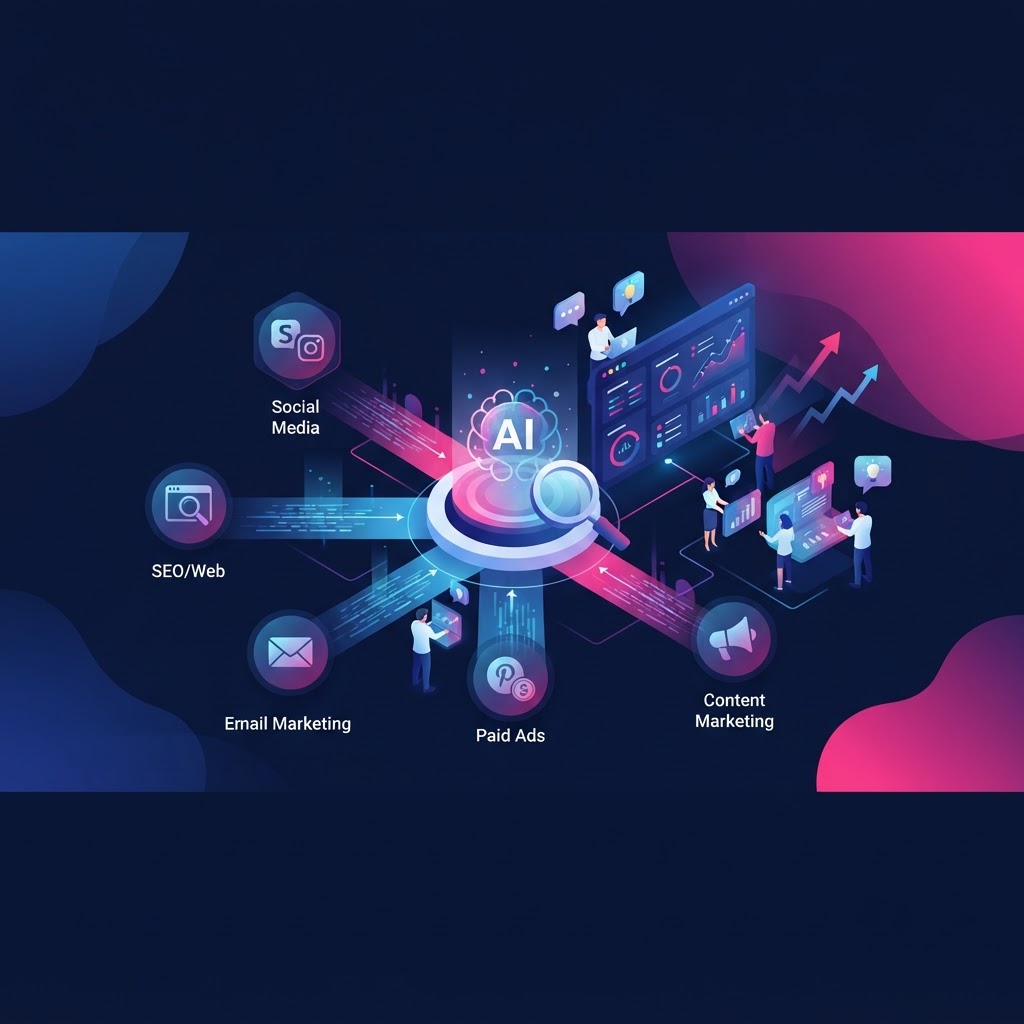
You are likely juggling a dozen different platforms to reach your customers, but without a clear view of how they interact, you are missing out on significant growth opportunities. By mastering cross-channel marketing analytics, you will finally gain the clarity needed to stop guessing which tactics work and start investing your budget where it delivers the highest return.
Short on time? Enter your website and see what it would write for your business — free, in about 30 seconds.
Why Small Businesses Struggle with Data Silos
The primary hurdle for most small businesses is the data silo effect. When your Facebook ad data lives in one app, your email open rates live in another, and your website traffic is tracked in a third, you lose the full picture of the customer journey. You might see a spike in traffic from a social media post, but if you cannot link that traffic directly to a completed purchase via an email discount code, you are merely looking at fragments. Fragmentation in marketing stacks is one of the leading causes of budget inefficiency in small enterprises, as owners often struggle to calculate a true return on investment (ROI) across disjointed channels. This manual reconciliation is not just tedious; it is prone to human error and often leads to decision-making based on outdated information.
The Strategic Advantage of AI in Marketing Analytics
AI-driven marketing reporting transforms raw data into actionable insights by removing the manual labor of data entry and spreadsheet analysis. AI tools can automatically detect anomalies, such as a sudden dip in website conversions, and correlate them with changes in your social media automation performance. This speed allows for real-time adjustments, ensuring you never waste money on underperforming channels. By implementing marketing automation software, you shift your focus from gathering data to acting on it. Instead of spending five hours a week cleaning spreadsheets, you spend that time optimizing your highest-performing landing pages or refining your ad copy based on predictive patterns that suggest what your customers want to see next.
Benefits of Unified Data
- Elimination of manual reporting errors.
- Real-time visibility into the customer conversion path.
- Better allocation of advertising spend based on verified performance.
- Predictive modeling that identifies future trends before they peak.
How to Consolidate Your Marketing Metrics
To effectively manage your data, you must move away from manual reporting. Start by identifying your key performance indicators (KPIs) and selecting a tool that integrates your primary traffic sources. Many small businesses find that using an AI marketing assistant helps streamline this, as these agents can summarize data trends into plain-language reports. Focus on tracking unified conversion metrics across every channel rather than looking at vanity metrics like likes or impressions in isolation. A vanity metric shows popularity, but a conversion metric shows survival.
Putting Cross-Channel Analytics into Practice
To start, audit your current marketing stack. Ensure that every tool you use—whether it is for automated social media posting or email outreach—can export data or integrate directly with your central dashboard. Create a weekly data sync ritual where you review the AI-generated report for the week. Look specifically for the cost per acquisition across different platforms. If one channel is costing twice as much to acquire a customer as another, shift your budget accordingly. This is the essence of effective small-business marketing automation.
Common Mistakes to Avoid
- Over-relying on vanity metrics: Stop prioritizing clicks if they do not lead to sales.
- Ignoring the attribution window: Understand that a customer may click an ad on Monday but only purchase through your newsletter on Friday.
- Failing to test: Never assume a channel is dead until you have tested at least three different variations of your creative content.
- Manual data entry: If you are still copying and pasting numbers into Excel, you are creating a bottleneck that prevents you from reacting to market shifts in real time.
By unifying your analytics, you transform your marketing from a series of disjointed experiments into a cohesive machine. Start small by connecting your top two channels today, and watch how quickly your efficiency improves once you have the full story of your customer's journey.
Related Reading
- Building a Marketing Dashboard for Data-Driven Small Business Decisions
- How to Use AI for Automated B2B Lead Nurturing Without a Large Team
- How to Automate Social Media Reporting Using AI Agents
See what it writes for YOUR business
Go to promomax.ai right now, enter your website, and get custom posts written for your business in about 30 seconds — free, no credit card. That's hundreds of posts a month on autopilot, written in your voice, published while you run your business. 7-day money-back guarantee, cancel anytime.
Get my free posts