
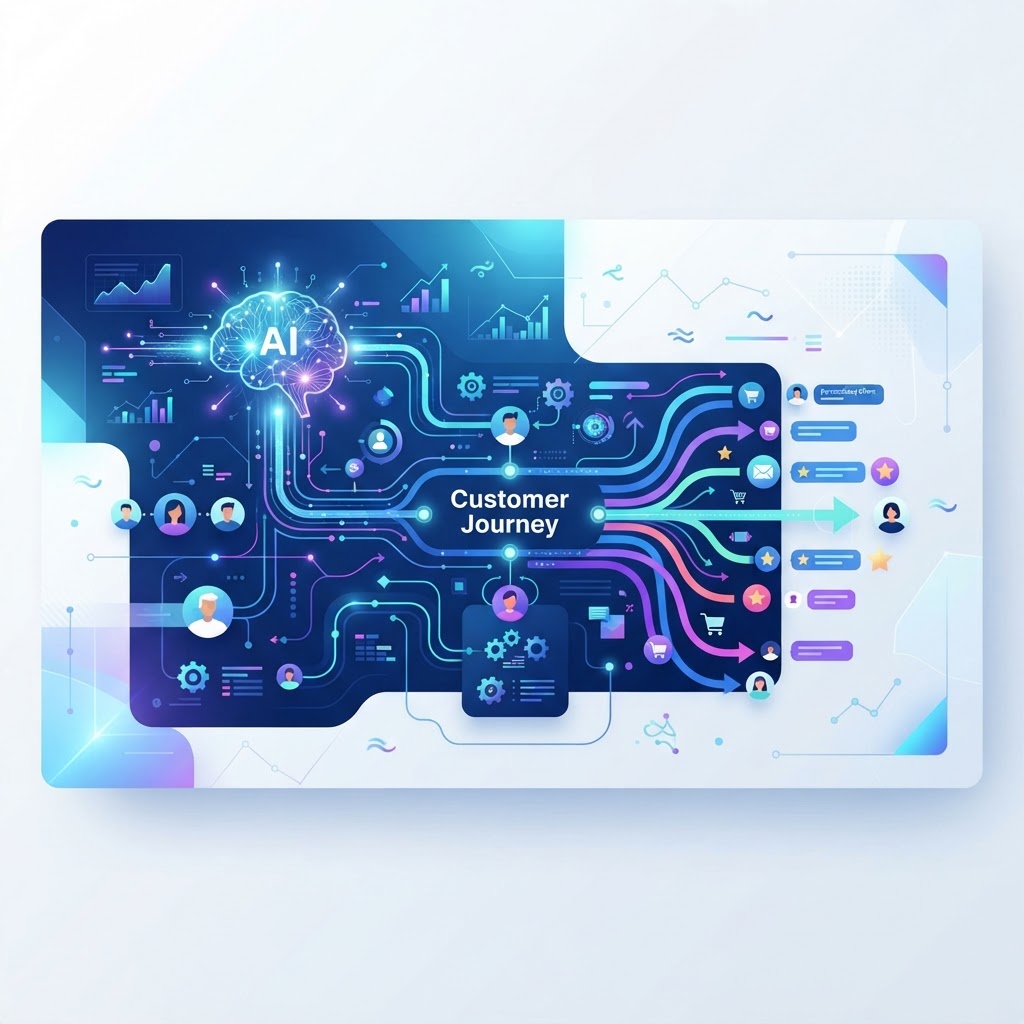
You likely know the frustration of sending a marketing campaign to your entire list, only to see open rates that barely crack double digits. If you want to grow, you must learn to personalize customer journey with AI to ensure every interaction feels like a private conversation rather than a generic broadcast.
Short on time? See what it would write for your business — free, in about 30 seconds.
The Shift to AI-Driven Personalization
For most small business owners, personalization has historically meant using a mail-merge tag to insert a first name into an email subject line. However, modern consumers expect far more. They expect you to anticipate their needs based on what they have browsed, bought, or even abandoned in their shopping cart. True personalization involves understanding behavior and purchase history to provide a seamless experience across every touchpoint.
Small businesses often believe that high-level data analysis is reserved for large corporations with massive budgets. This is a misconception. AI democratizes data processing, allowing you to identify hidden patterns in your sales data in a matter of hours. By automating the heavy lifting of data analysis, you can shift your focus from manually crunching spreadsheets to crafting compelling narratives that speak to your customers' unique pain points.
Using Customer Segmentation AI to Improve Targeting
The foundation of effective engagement is precise segmentation. Instead of grouping all customers into one master list, use AI marketing tools to categorize users based on micro-behaviors. Static segments like age or location are useful, but behavioral segments are powerful because they reflect intent.
For example, you might automatically segment customers who visit your pricing page but do not checkout, versus those who have purchased three times in the last year. By leveraging AI to distinguish between these two groups, you can tailor your messaging effectively. The former might need a case study or a testimonial to build trust, while the latter might be ready for an exclusive loyalty reward. Common mistakes here include over-segmenting, which leads to tiny, unmanageable lists, or under-segmenting, which leads to messages that feel irrelevant to half your audience.
The Power of Predictive Modeling
Predictive AI goes a step further by identifying which customers are most likely to churn or, conversely, which ones are ready for an upsell. By scoring your customers based on their interaction frequency and recency, your AI tools can prioritize outreach. This ensures your marketing team is spending energy on the leads most likely to convert today.
Implementing Personalized Marketing Automation
Once your segments are defined, personalized marketing automation ensures that the right message reaches the right person at exactly the right time. AI tools can trigger specific actions based on real-time behavior. If a visitor spends significant time on a specific service page, the AI can trigger an email with a helpful guide or a specific discount code related to that service.
This strategy turns cold leads into warm ones without you needing to monitor your accounts around the clock. The key is to keep these automations helpful rather than intrusive. A well-timed email that offers a solution to a problem a user just researched will be perceived as a benefit, not as spam.
Putting It Into Practice: A Tactical Approach
To start building these journeys, follow these concrete steps to ensure your technical setup supports your strategy:
- Centralize your data: Ensure your CRM or email platform captures meaningful user actions such as clicks, specific page visits, and time spent on your site. Without a single source of truth for your data, AI cannot draw accurate conclusions.
- Identify high-value actions: Define the top three actions that correlate with a sale in your business. This could be downloading a white paper, viewing a demo video, or adding an item to a cart.
- Automate triggers: Set up workflows that respond immediately to those actions with helpful content. If someone downloads a resource, set a trigger to send a follow-up email three days later with a related case study.
- Refine with A/B testing: Use AI to test different subject lines or offers automatically. By letting the platform determine which variation performs better for each specific segment, you continuously improve your conversion rates.
By shifting to an AI-augmented strategy, you stop guessing what your customers want and start responding to what they tell you through their actions. The result is a more resilient business that builds loyalty through relevance.
Related Reading
See what it writes for YOUR business
Go to promomax.ai right now, enter your website, and get custom posts written for your business in about 30 seconds — free, no credit card. That's hundreds of posts a month on autopilot, written in your voice, published while you run your business. 7-day money-back guarantee, cancel anytime.
Get my free posts