
AI Marketing Orchestration: A Practical Guide for Small Businesses
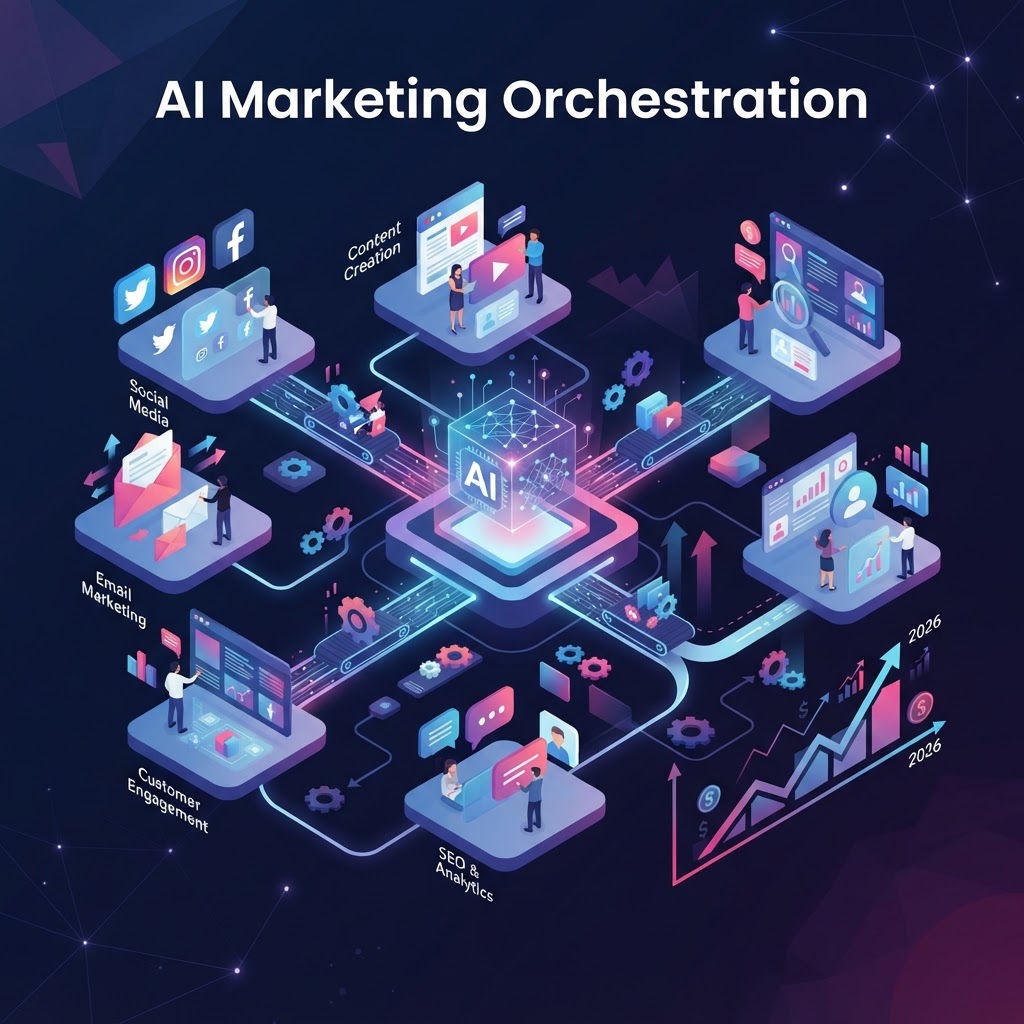
You are likely tired of juggling a dozen different browser tabs just to launch a single campaign. AI Marketing Orchestration is the process of using autonomous AI systems to coordinate, execute, and optimize multiple marketing tasks—like content creation, social media posting, and lead engagement—into a single, cohesive workflow designed to cut down on the manual back-and-forth between separate tools. By reading this guide, you will learn how to shift from managing individual tools to overseeing a unified engine that runs your growth strategy, and how to check which parts of that workflow actually save you time once you measure them.
Short on time? Enter your website and see what it would write for your business — free, in about 30 seconds.
What Does AI Marketing Orchestration Actually Change?
In traditional marketing, you likely switch between a scheduling tool, a writing assistant, and a design platform. This fragmented approach often leads to inconsistent messaging, branding drift, and lost productivity. AI Marketing Orchestration replaces this app fatigue by treating your marketing channels as an interconnected ecosystem. Instead of manually copying and pasting content from an AI generator to a social media scheduler, your orchestrator acts as the central brain. It takes a core message and atomizes it into blog posts, social captions, and email newsletters, all while ensuring the voice remains consistent. Of marketers, 55% now use AI for text-based content like blogs and campaigns, giving small businesses a way to create more high-quality content with fewer resources. It's worth testing how much manual overhead an orchestrated workflow actually removes for your specific team.
Why Do Small Businesses Need to Orchestrate Instead of Just Automate?
Automation is a static tool that performs a single, repetitive task, such as posting a photo at a specific time. While helpful, it lacks intelligence. Orchestration, however, uses intent and logic to make real-time decisions. For example, an orchestrated system doesn't just post content; it monitors engagement, adjusts the tone based on audience sentiment, and synchronizes the message across all platforms simultaneously. This moves your business toward marketing on autopilot. When your strategy evolves in real-time based on actual customer behavior rather than a pre-set calendar, you reach customers with the right message at the exact moment they are ready to buy.
Concrete Steps to Implement AI Orchestration
You do not need a massive team or a computer science degree to start. Follow this framework to transition your operations:
- Audit your stack: List every tool you pay for and identify where your data silos are. Look for gaps where information isn't moving between platforms.
- Centralize your assets: Store your brand voice guidelines, product specs, and customer personas in one location that your AI agents can access.
- Connect your triggers: Use integration platforms to ensure that when a new lead enters your CRM, a personalized welcome sequence is automatically triggered.
- Iterate with data: Use the reporting features within your orchestration platform to see which channels drive the highest conversion.
The goal is to move from manual, platform-specific tasks toward a centralized model of AI marketing for small business, which allows your systems to talk to one another without human intervention.
How Does AI Marketing Orchestration Impact ROI?
By streamlining your workflow, track your cost per acquisition (CPA) over time to see whether more targeted efforts are actually lowering your costs. When you stop manually tweaking individual posts and start using AI marketing agents, compare performance across channels to see where your content spend is working hardest. This transition is essential for scaling digital marketing for small business without increasing your headcount. A common mistake is trying to orchestrate too many channels at once; start with your primary lead-generation channel, optimize it, and then expand. By auditing your current marketing automation, you can identify which processes are currently draining your budget and evaluate whether AI-driven workflows actually improve them.
Frequently Asked Questions
Is AI Marketing Orchestration the same as AI content generation?
No. Content generation is just one piece of the puzzle. Orchestration coordinates that content with scheduling, distribution, and performance analysis, ensuring your messaging remains consistent across all touchpoints.
Do I need technical skills to orchestrate my marketing?
Not with current tools. Modern AI orchestration platforms are designed for small business owners, meaning they handle the complex logic behind the scenes so you can focus on strategy.
Will AI replace my marketing creativity?
AI acts as a force multiplier for your creativity. It handles the repetitive heavy lifting, allowing you to focus on high-level strategy, brand voice, and customer relationship building.
How quickly can I see results?
Efficiency gains from orchestration vary by business, so track the time you spend on scheduling and reporting before and after implementation to see whether it's actually recovering time for you. According to the 2025 Impact of Social Media Report, 58% of teams rated as experts at measuring the business impact of social rely on social media management tools to do it.
Related Reading
- AI Content Quality: A Practical Guide for Small Businesses
- AI Marketing Compliance: A Practical Guide for Small Businesses
- Agentic AI for Marketing: A Practical Guide for Small Businesses
See what it writes for YOUR business
Go to promomax.ai right now, enter your website, and get custom posts written for your business in about 30 seconds — free, no credit card. That's hundreds of posts a month on autopilot, written in your voice, published while you run your business. 7-day money-back guarantee, cancel anytime.
Get my free posts