
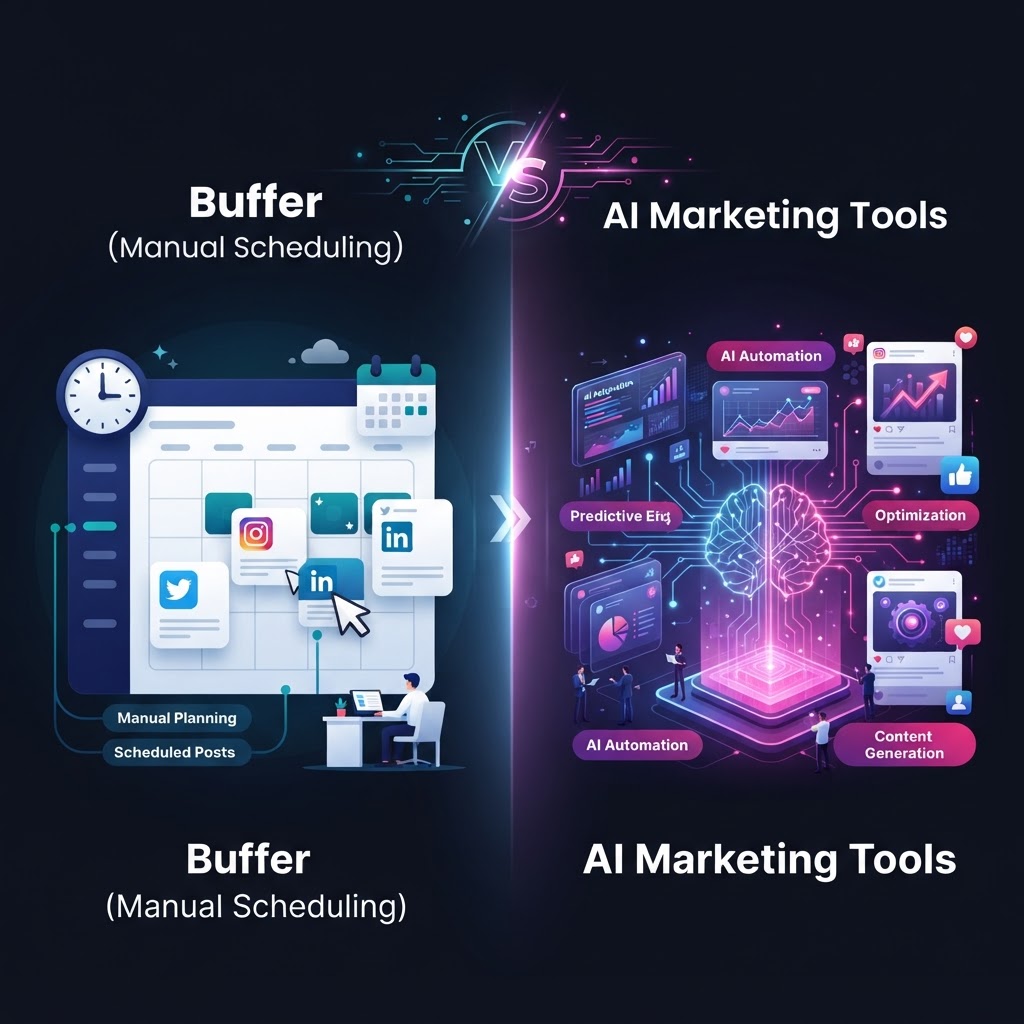
When you sit down to plan your social media calendar, do you find yourself feeling like a glorified administrative assistant rather than a business owner? Choosing between Buffer vs AI marketing tools: what is the difference? ultimately comes down to whether you want to spend your limited energy managing manual workflows or building a scalable growth engine. By the end of this guide, you will understand exactly which category your business needs to survive and thrive in a crowded digital landscape.
Short on time? Enter your website and see what it would write for your business — free, in about 30 seconds.
What does Buffer do for small businesses?
Buffer is widely regarded as a staple in the social media management space because of its reliability as a scheduling tool. It excels at being a digital calendar. If you have a marketing team that generates assets, writes copy, and creates graphic designs, Buffer is the final stop in your production line. It allows you to organize these disparate pieces into a cohesive visual timeline.
However, the limitation is inherent in the design: Buffer acts as a delivery system. It does not think for you. It requires you to be the strategist, the copywriter, and the researcher. Small business owners often fall into the trap of using Buffer to feel productive while ignoring the fact that they are still performing every creative task manually. If you are struggling to find time to produce the content itself, a scheduling tool like Buffer effectively just helps you publish your backlog of incomplete or uninspired ideas.
How do AI marketing tools change the game?
AI marketing tools shift the focus from logistical management to autonomous growth. Instead of treating social media as a place to dump pre-made files, an AI platform functions as a member of your team that never sleeps. These platforms integrate AI content marketing by analyzing your specific industry trends, customer pain points, and brand voice to produce ready-to-post material automatically.
The shift is profound because it removes the blank page syndrome. You no longer have to ask, what should I post today? An AI system provides the answer based on data patterns it has learned about your audience. By leveraging AI marketing agents, you move toward a model of constant optimization where the platform suggests improvements based on engagement metrics, refining its output over time to ensure higher conversion rates.
Comparison of capabilities
| Feature | Buffer | AI Marketing Tools (e.g., PromoMax) |
|---|---|---|
| Content Creation | None (Manual) | Automated AI Generation |
| Strategy Development | Manual | AI-Driven Optimization |
| Time Investment | High | Low (Automated) |
| Execution | Scheduled Posting | Always-On Automation |
The hidden costs of manual scheduling
Many entrepreneurs believe that manual scheduling is safer because they have full control over the output. However, this often leads to common mistakes that stifle growth:
- Inconsistent posting cadences because you were too busy to manually queue content.
- Generic copy that fails to address specific customer needs.
- Failure to react to trending topics in real time because the content was written days or weeks in advance.
- Resource drain, where you spend 10 hours a week just moving files into a calendar rather than engaging with clients.
By moving to automated marketing, you reclaim those lost hours. A typical workflow with an AI-driven tool looks more like a high-level review process rather than a production process. You define the objectives, and the AI handles the implementation.
Putting It Into Practice: How to Transition
To make the switch, you must first audit your current output. If your process involves brainstorming, writing in a separate document, sourcing images, and then manually uploading to a calendar, you are operating on a legacy model. Modern businesses are moving toward a set-it-and-forget-it approach where the AI generates, schedules, and optimizes the content for you.
- Evaluate your weekly time usage: Track exactly how many hours you spend on social media. If you hit more than 5 hours, you are over-allocating resources to low-leverage tasks.
- Define your goals: Identify if you are posting for brand awareness, direct sales, or customer support.
- Test the automation: Use an AI tool to generate one week of content and compare it against your manual efforts. You will likely notice that the AI is capable of producing more diverse angles in a fraction of the time.
Transitioning from manual management to AI automation is not about letting software replace your brand voice. It is about removing the friction of execution so that you can focus on the business activities that actually generate revenue.
Related Reading
- Buffer vs AI marketing tools: is it worth switching?
- Buffer vs AI marketing tools for automated posting
- Buffer vs AI marketing tools like PromoMax or Sintra
See what it writes for YOUR business
Go to promomax.ai right now, enter your website, and get custom posts written for your business in about 30 seconds — free, no credit card. That's hundreds of posts a month on autopilot, written in your voice, published while you run your business. 7-day money-back guarantee, cancel anytime.
Get my free posts