
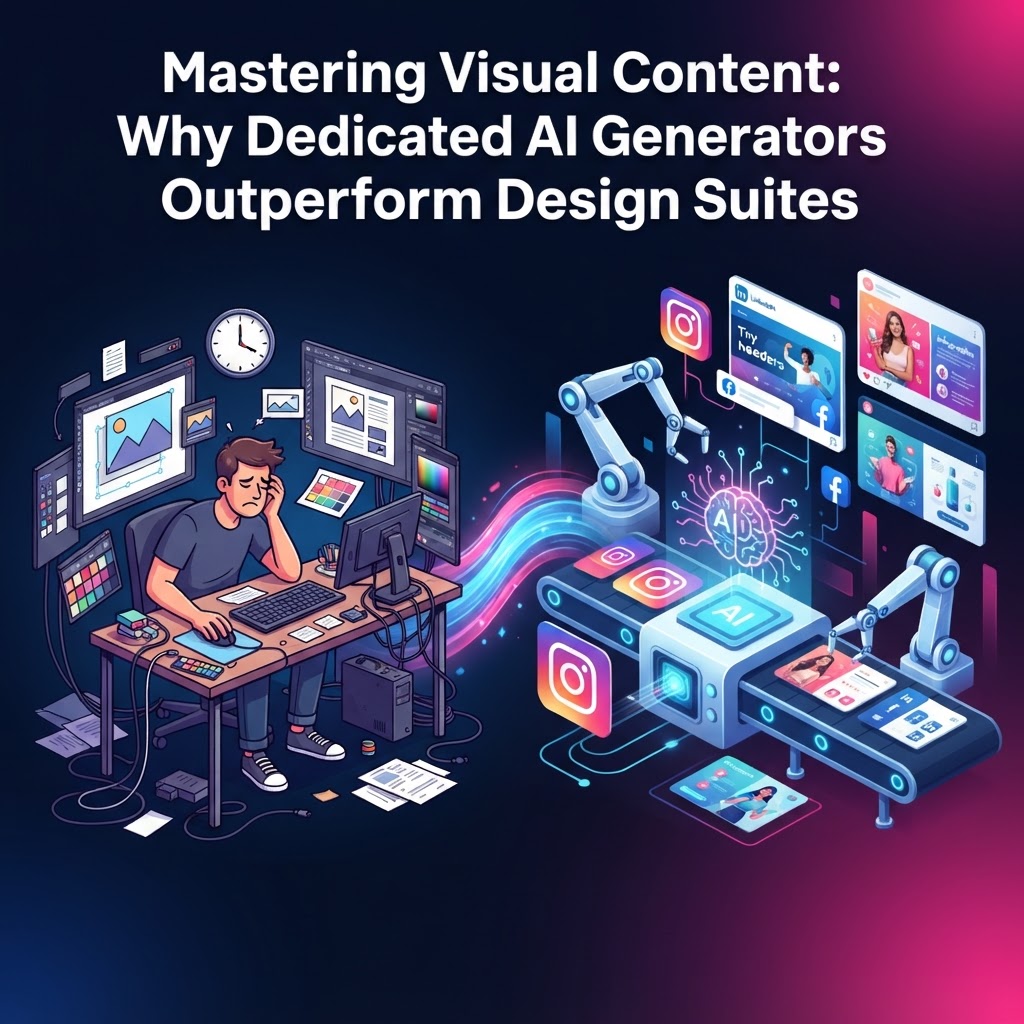
You are likely tired of spending your precious mornings wrestling with layers, alignment tools, and font pairings just to get a single post onto your Instagram feed. By mastering AI social media design automation, you will stop acting as a graphic designer and start operating as a high-level creative director, regaining hours of your week while maintaining a polished brand image. This transformation allows you to treat visual production as a systematic output rather than a draining, manual project.
Short on time? Enter your website and see what it would write for your business — free, in about 30 seconds.
Why Do Traditional Design Suites Fail Small Teams?
Traditional design tools offer infinite control, but that freedom often acts as a productivity bottleneck for growing companies. When your objective is consistent, high-frequency posting rather than a single, bespoke artistic masterpiece, the blank canvas approach forces you to make hundreds of micro-decisions—font weight, hex code adjustments, spacing, and layout flow—every single time you need to share a business update. This cognitive load is immense.
Small teams often report that the constant need to design from scratch prevents them from being consistent. When you spend 45 minutes on one graphic, you are inevitably neglecting your customer engagement, community outreach, and sales pipeline. Scaling social media graphics requires a process that eliminates the repetitive setup phase. You do not need a new design app; you need a system that prioritizes output volume over individual pixel perfection.
How Does AI-Native Generation Change The Workflow?
AI-native generators function fundamentally differently because they are built on context. Instead of selecting a generic template and manually swapping out photos and text, you input your AI content creation parameters, and the system synthesizes a complete, ready-to-post asset. This is automated visual content creation at its peak.
The Power of Context-Aware Branding
- Input your brand assets once and let the model handle the placement.
- The AI understands that your logo must remain in the top right corner regardless of the layout.
- The system automatically adjusts text hierarchy so your main headline is always the most legible element.
By leveraging machine learning, these platforms ensure that every graphic adheres to your visual identity without requiring constant supervision. You are essentially building a digital assembly line where the product is consistent, high-quality visual content.
Is AI Quality Good Enough For Professional Business Needs?
Recent breakthroughs in generative models have effectively closed the gap between automated outputs and professional agency-grade design. Early iterations of these tools struggled with text rendering and visual composition, but current systems are now highly sophisticated. When integrated with social media automation, these visuals are not just created in a vacuum; they are instantly resized for different platforms and deployed to your channels.
Key Features of Modern AI Outputs
- Cross-Platform Optimization: One generation produces variations for Stories, feed posts, and banners.
- Brand Consistency: AI ensures that the exact colors and spacing are applied to every single graphic, preventing the drift often caused by manual editing.
- Dynamic Text Injection: The AI can pull live data or specific product descriptions directly into the design layout.
How Much Control Do You Retain Over The Creative Output?
Using an AI-first approach does not mean losing your unique brand voice. In fact, you retain higher-level creative authority by setting the foundational guardrails. You define the tone, primary colors, and target audience persona once, and the AI marketing assistant applies those rules to every asset. This governance model is the secret to successful small business marketing automation because it removes the risk of off-brand content being posted by human error.
Putting It Into Practice: A 3-Step Transition
To transition from manual design to an automated flow, follow this framework:
- Step 1: Audit your most successful posts from the last quarter to identify common design patterns.
- Step 2: Define your visual must-haves, such as mandatory logo placement and your primary brand font family.
- Step 3: Shift your workflow to a platform that supports AI social media marketing, allowing the tool to manage the heavy lifting of design.
By delegating the layout and asset generation to an AI, you gain the time needed to engage with your community, answer customer questions, and refine your overall strategy. The goal is to move away from the pixel-pusher mentality and move toward a growth-focused mindset.
Related Reading
- Mitigating AI Output Fatigue: Strategies for Dynamic Content Refreshing
- Optimizing Video Content Performance with AI Analytics
- Mitigating AI Brand Drift: Maintaining Consistency at Scale
See what it writes for YOUR business
Go to promomax.ai right now, enter your website, and get custom posts written for your business in about 30 seconds — free, no credit card. That's hundreds of posts a month on autopilot, written in your voice, published while you run your business. 7-day money-back guarantee, cancel anytime.
Get my free posts