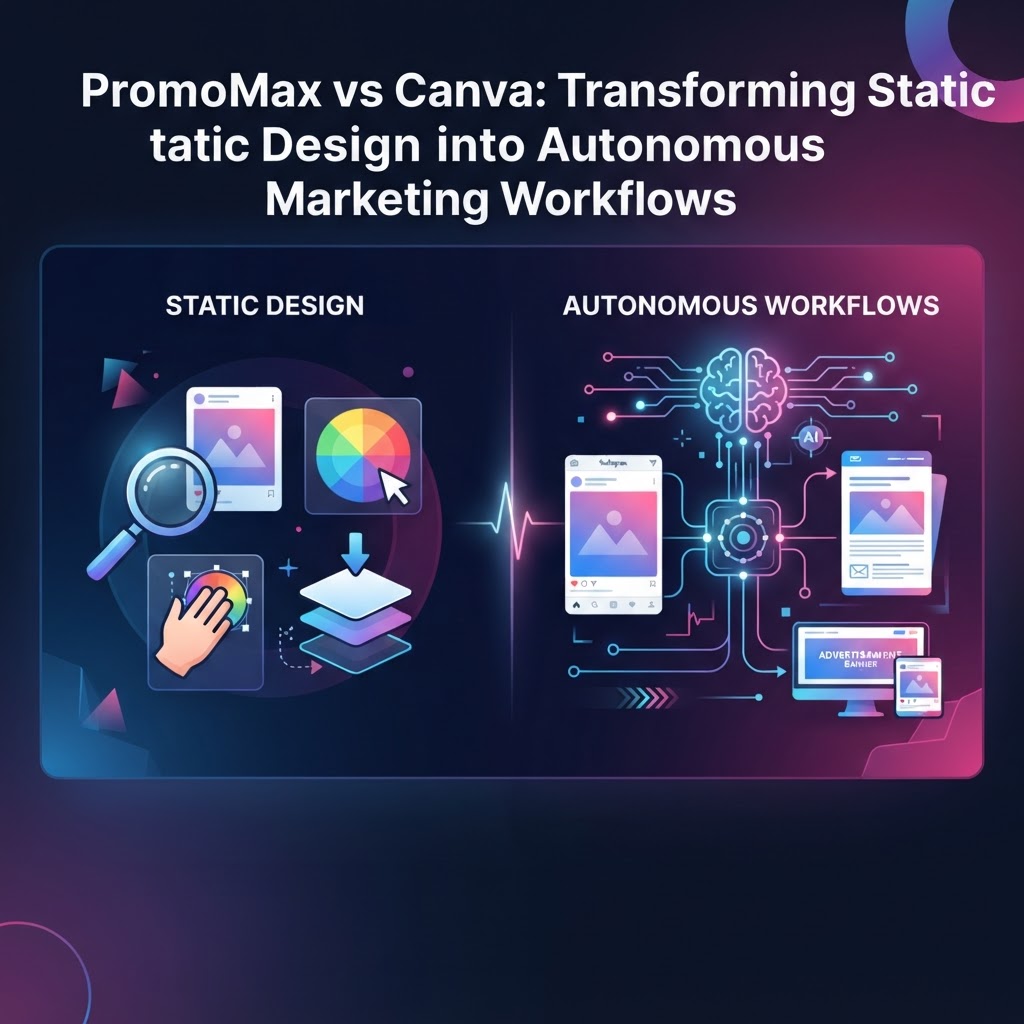
If you are a small business owner caught in the endless cycle of manual design, your path to scaling just became significantly clearer. In this comparison of PromoMax vs Canva design automation features, you will learn why shifting from a manual toolkit to an autonomous engine is the secret to reclaiming your time and scaling your brand presence without burning out.
Short on time? Enter your website and see what it would write for your business — free, in about 30 seconds.
Why Manual Design Tools Become Growth Bottlenecks
For most entrepreneurs, Canva feels like a blessing at first. It offers beautiful templates and an intuitive interface. However, as your business matures, you encounter the reality of manual design fatigue. You are not just a designer; you are the CEO, the lead salesperson, and the customer support team. Every hour spent dragging text boxes and adjusting image filters is an hour taken away from high-impact strategic tasks.
The fundamental issue is that Canva is a creation tool, not a marketing strategy tool. It requires human intervention for every single asset. If you need to produce content for Instagram, LinkedIn, and Facebook, you are often performing the same tasks three times over. This creates a bottleneck where your output is capped by your own manual labor. When growth requires volume, manual design forces you to choose between quality and frequency.
PromoMax vs Canva Design Automation Features: The Structural Divide
When analyzing PromoMax vs Canva design automation features, it is vital to understand that they operate on different tiers of technology. Canva is built for manual pixel-level control. PromoMax is built for intent-based generation. Here is how they differ in a practical business environment:
The Manual Content Lifecycle
- Design: Picking a template and manually inputting text.
- Customization: Adjusting brand colors, fonts, and imagery for each platform.
- Exporting: Downloading files and managing local storage.
- Scheduling: Manually moving assets to a secondary platform for posting.
The Autonomous Content Lifecycle
- Contextual Analysis: The system analyzes your website and brand history to understand your unique value proposition.
- Autonomous Generation: The engine crafts, designs, and formats content tailored to specific social media algorithms.
- Self-Optimization: Instead of guessing what works, the system reviews engagement metrics to refine subsequent posts automatically.
- Ongoing Distribution: Content is published consistently without you needing to press a single button.
Comparing Core Capabilities
| Feature | Canva | PromoMax |
|---|---|---|
| Design Philosophy | Manual, template-based | Autonomous, agent-based |
| Content Lifecycle | Manual creation/export | End-to-end automation |
| Strategy Integration | Isolated design | Unified content strategy |
| Scaling Potential | Linear (requires more time) | Exponential (managed by AI) |
The Hidden Cost of 'Do-It-Yourself' Design
Many business owners underestimate the 'hidden cost' of manual marketing. It is not just about the monthly subscription fee. It is the cost of your cognitive load. When you are constantly focused on the aesthetics of a post, you often lose sight of the conversion goal. You might make a post look beautiful, but does it drive a lead to your AI content creation landing page? Does it follow a logical sequence that moves a prospect from awareness to purchase? Manual design rarely accounts for the customer journey.
Common Mistakes in Manual Marketing
- Over-editing: Spending 45 minutes on a post that only has a 2-second lifespan on a feed.
- Platform Misalignment: Posting the exact same design across all channels rather than optimizing for platform-specific behavior.
- Inconsistency: Creating content in bursts followed by long periods of silence due to time constraints.
Transforming Strategy Through Autonomous Workflows
To move beyond static design, stop viewing your content as things you need to make and start viewing them as data points in your growth engine. Implementing a system that handles your marketing automation allows you to move from the role of a creator to the role of an architect. When you let the software handle the production, you gain the mental clarity to focus on business-level decisions like partnerships, product development, and customer acquisition. The future of small business marketing is not about who can design the fastest, but who can build the most effective automated system for consistent, high-conversion communication.
Related Reading
- PromoMax vs Canva: Beyond Visual Templates to Automated Workflows
- Optimizing Your Marketing Stack for 2026: Consolidation Strategies
- How do I use AI to create Social Media content for my business?
See what it writes for YOUR business
Go to promomax.ai right now, enter your website, and get custom posts written for your business in about 30 seconds — free, no credit card. That's hundreds of posts a month on autopilot, written in your voice, published while you run your business. 7-day money-back guarantee, cancel anytime.
Get my free posts