
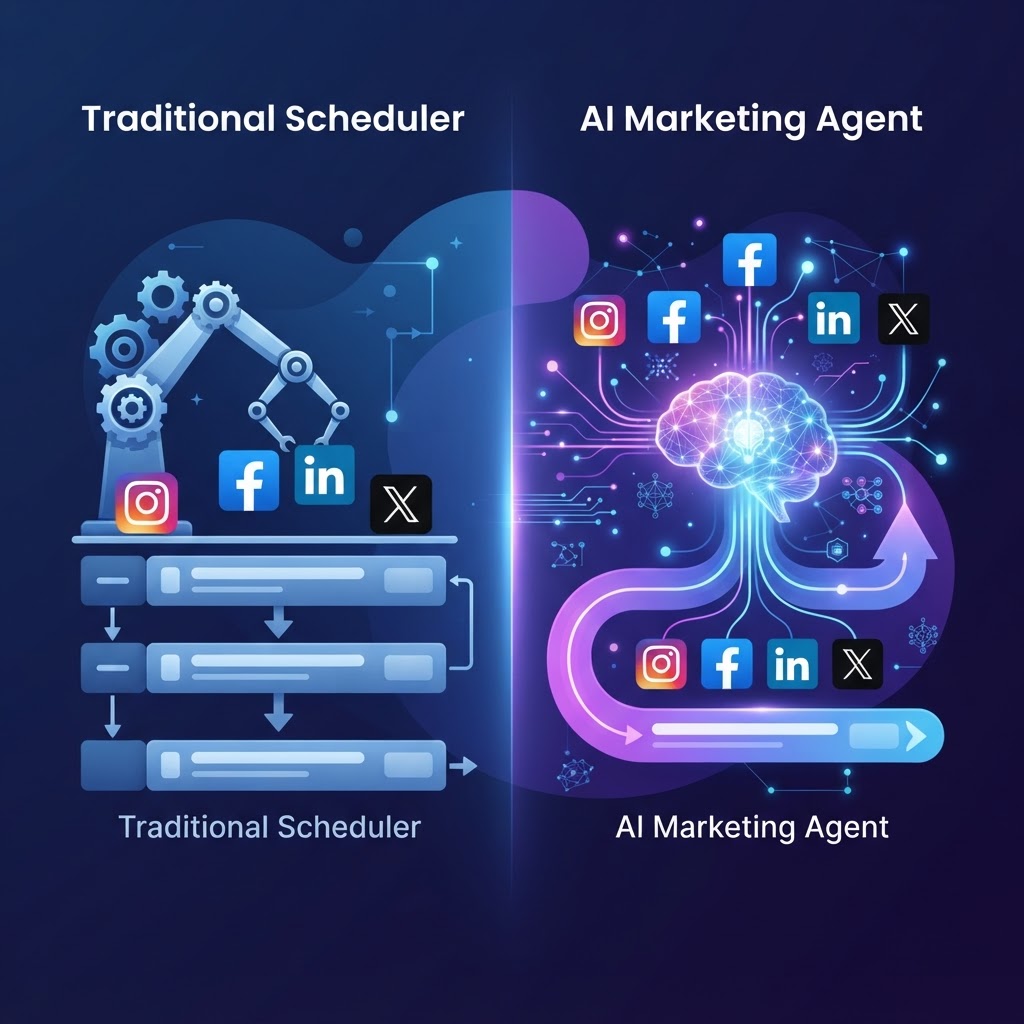
You are likely tired of the relentless cycle of content creation that leaves little time to actually run your business, so understanding the shift from traditional social media schedulers vs AI marketing agents is the key to reclaiming your schedule. By the end of this guide, you will discover how to transition from a manual, reactive workflow to a proactive, automated system that grows your brand while you focus on high-value tasks.
Short on time? Enter your website and see what it would write for your business — free, in about 30 seconds.
The Evolution of Your Social Media Stack
Traditional social media schedulers were designed for a simpler era of digital marketing where you controlled every variable. They are essentially digital filing cabinets that store your posts until a pre-determined time arrives. While useful for maintaining consistency, they require you to be the strategist, the copywriter, the graphic designer, and the data analyst every single day. This creates a massive operational bottleneck, especially for small teams where the owner wears every hat.
In contrast, AI marketing agents represent a fundamental shift in how businesses handle digital presence. They act as autonomous, intelligent partners that execute complex workflows. Instead of just pushing a button to publish, an AI agent understands your brand voice, observes what is trending in your specific niche, and continuously refines its output based on what actually resonates with your audience. The comparison between traditional social media schedulers vs AI marketing agents is really a comparison between a tool that obeys commands and a system that solves problems.
Why Manual Scheduling Has Become a Growth Ceiling
Most small businesses rely on manual scheduling because it feels safe, but it often leads to burnout and diminishing returns. When you spend hours every week copy-pasting text into a queue, you are neglecting the high-level decision-making that drives revenue. Here is why the manual model is failing many entrepreneurs:
- Content Stagnation: Because you only have time to post what you can create manually, your content lacks the variety needed to capture attention across different platforms.
- Feedback Loops are Too Slow: By the time you notice a post performed poorly, you have already spent hours creating the next batch of similar, ineffective content.
- The Blank Page Syndrome: Sitting down to draft thirty days of content at once is mentally exhausting, leading to inconsistent messaging and a drop in quality.
By leveraging social media automation via agentic workflows, you eliminate these bottlenecks. Instead of starting from scratch, you provide your agent with a set of goals and brand guidelines. The AI takes over the heavy lifting of drafting, formatting, and timing the posts, allowing you to function as a director rather than a factory worker.
Comparing Operational Capabilities
To truly grasp the shift, look at how these tools handle everyday marketing tasks:
| Feature | Traditional Scheduler | AI Marketing Agent |
|---|---|---|
| Content Generation | Manual | Autonomous/AI-led |
| Strategy Adaptation | None | Real-time optimization |
| Platform Interaction | Passive | Proactive Engagement |
| Workflow Intensity | High (Manual) | Low (Supervisory) |
The Reality of Moving to Agentic Workflows
Transitioning away from manual tools does not mean losing control of your brand. In fact, it gives you more control by providing you with deeper insights. To start, you should audit your current engagement. Identify which posts over the last quarter drove actual inquiries or sales. Then, use an AI post generator to replicate that success on a larger scale by testing subtle variations in tone and imagery.
A common mistake is trying to automate everything overnight without setting clear boundaries. Start by defining your brand pillars and tone of voice. When the AI understands your unique value proposition, it produces content that feels human and authentic. Over the course of 30 days, compare the engagement metrics of your AI-generated posts against your old manually scheduled ones. You will likely see that the AI learns to iterate faster than a human, finding the exact mix of timing and messaging that your audience prefers.
FAQ
Do AI agents replace the need for human strategy?
No. AI marketing agents act as an extension of your team, handling repetitive execution so you can focus on high-level brand vision and complex decision-making.
Are AI marketing agents expensive?
While costs vary, moving to an AI-first model often saves money compared to hiring additional staff or paying for multiple disparate software subscriptions, especially when using integrated platforms like PromoMax.
How long does it take to switch from a scheduler to an agent?
Most small businesses can integrate an AI agent workflow within a few days by connecting their social accounts and defining their brand voice guidelines within the dashboard.
Is my data safe with AI marketing agents?
Reputable platforms ensure data encryption and maintain strict privacy standards. PromoMax is built with enterprise-grade security specifically for small business operations.
Related Reading
- Why You Need a 'Marketing Agent' Instead of a Tool
- How to Scale Your Marketing Without Hiring
- Why Your Business Needs AI Agents Now
See what it writes for YOUR business
Go to promomax.ai right now, enter your website, and get custom posts written for your business in about 30 seconds — free, no credit card. That's hundreds of posts a month on autopilot, written in your voice, published while you run your business. 7-day money-back guarantee, cancel anytime.
Get my free posts