
If you have ever felt like you are just spinning your wheels on social media without seeing a clear impact on your bottom line, you are not alone. Small business owners often reach a growth plateau where manual social media scheduling tools, like Buffer, may need to be paired with deeper strategy and analytics to support further business expansion. By reading this guide, you will learn how to evolve your workflow from simple task management to an integrated system that captures leads and drives revenue through a unified content strategy.
Short on time? Enter your website and see what it would write for your business — free, in about 30 seconds.
The Core Dilemma: PromoMax vs Buffer Unified Content Strategy
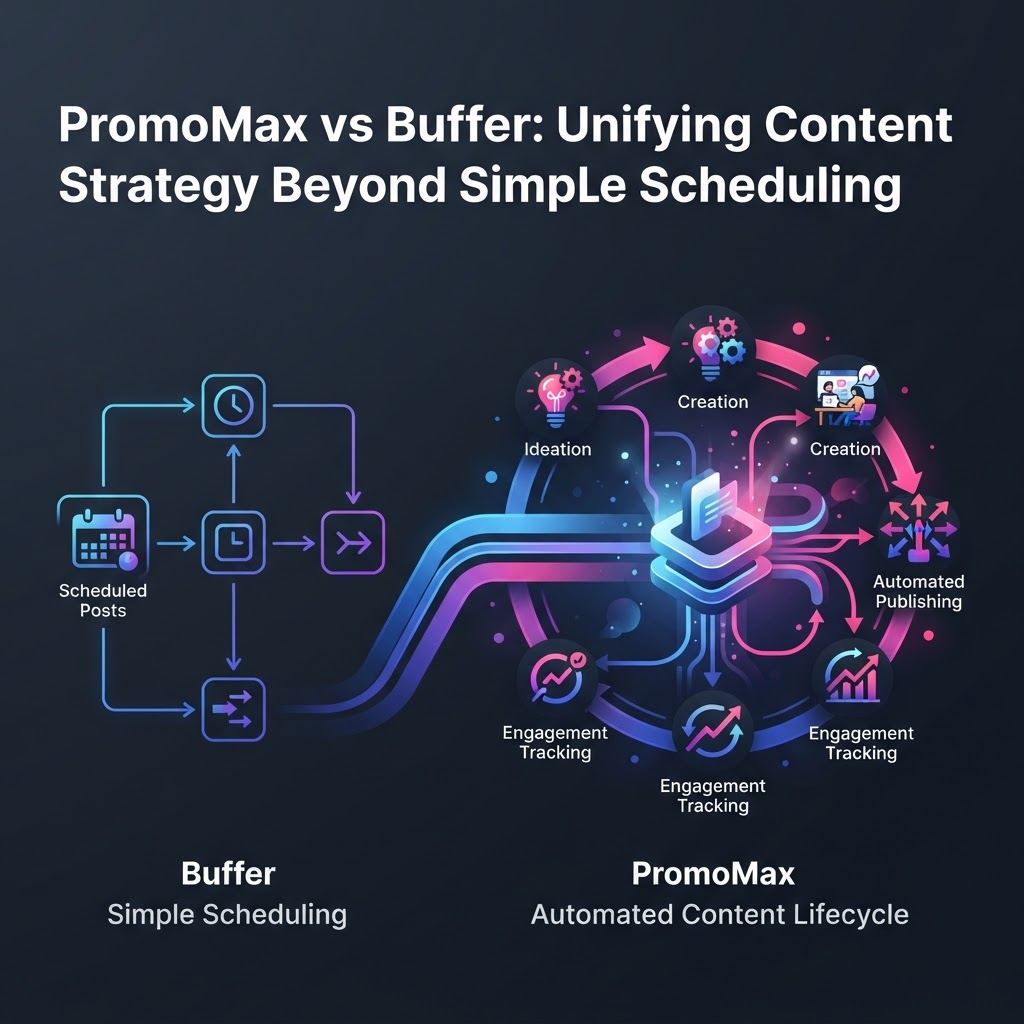
Buffer is organized around a posting calendar, which supports scheduling but not deeper strategy work. Before choosing a tool, clarify whether your team needs calendar scheduling alone or wants content creation, scheduling, and performance analytics connected in one system, such as the marketing automation approach described here, sometimes framed as an AI marketing team for content operations. Write down the business goal each post is meant to support, then check afterward whether that goal was met.
Defining Your Workflow Architecture
The primary distinction lies in the workflow architecture. Buffer focuses on the last mile of social media: getting content onto a platform at a specific time. Toggling between native platform dashboards makes it difficult to compare performance across platforms. Consider whether adopting a unified social media management tool resolves that comparison problem for your team. PromoMax uses AI content creation; track whether posts produced through it align with your broader business objectives before and after adoption, rather than assuming alignment happens automatically.
How Automated Content Lifecycle Management Changes Results
Manual tools require you to be both the strategist and the operator. You write, you design, you schedule, and you analyze. Track your messaging consistency across channels when managing social presence manually versus using automated content lifecycle management, such as AI marketing agents, to see which approach better maintains a cohesive brand story. Compare multi-channel distribution results before and after introducing these agents to determine whether they change consistency for your team.
| Feature | Buffer | PromoMax |
|---|---|---|
| Core Focus | Scheduling & Calendar | Full-Stack Marketing Automation |
| AI Integration | Varies by plan - compare current AI features | AI-assisted workflows - compare current automation features |
| Workflow Depth | Manual | Automated Lifecycle |
| Platform Logic | Siloed scheduling | Unified Marketing Stack |
Scaling Beyond Simple Scheduling
To scale your business, you must move away from the mindset of what to post tomorrow. Instead, focus on what campaign achieves this month's revenue goal. Automation allows you to batch-produce content and schedule it across channels based on audience performance data. For small teams, this shift is the difference between constant firefighting and predictable growth.
Concrete Steps to Level Up Your Strategy
- Define Your Revenue Pillar: Choose one core offer per month. Every piece of content generated should funnel the audience toward learning more about that specific offer.
- Audit Your Channel Performance: Stop posting to channels that do not convert. A unified platform allows you to see which channels contribute to sales rather than just vanity metrics like likes or shares.
- Adopt Agentic Workflows: Instead of crafting individual captions, utilize AI agents to generate multi-format content—such as blog posts, newsletters, and social snippets—that all point toward your primary objective.
- Refine Based on Data: Use the analytics dashboard within your unified platform to identify winning themes. If a specific topic drives clicks, let your AI agents double down on that subject for future weeks.
Common Mistakes to Avoid
- The Random Posting Trap: Posting without a clear call to action (CTA) in every post. If you are not telling the user what to do next, you are wasting the opportunity.
- Ignoring Cross-Channel Synergy: Running isolated campaigns on different platforms. Your email, social media, and blog content should act as a single, coherent funnel.
- Over-Reliance on Manual Editing: Spending hours refining a single caption instead of focusing on the broader message. Your time is better spent defining the strategy while your tools handle the execution.
By transitioning from a manual tool to a unified platform, you reclaim your most valuable asset: your time. As your business grows, your marketing infrastructure should grow with it, transforming from a manual chore into a reliable, autonomous system that delivers results while you focus on serving your customers.
Related Reading
- Unlocking Efficiency: When to Transition from Manual Scheduling to Agentic Marketing
- The Strategic Shift: Why Your Marketing Stack Needs AI Consolidation
- PromoMax vs Buffer: How to Automate Your Entire Content Lifecycle
See what it writes for YOUR business
Go to promomax.ai right now, enter your website, and get custom posts written for your business in about 30 seconds — free, no credit card. That's hundreds of posts a month on autopilot, written in your voice, published while you run your business. 7-day money-back guarantee, cancel anytime.
Get my free posts